mirror of
https://github.com/Cysharp/UniTask.git
synced 2026-05-15 11:30:09 +00:00
Compare commits
31 Commits
| Author | SHA1 | Date | |
|---|---|---|---|

|
1173bb4f34 | ||

|
e4272b5337 | ||
|
|
b660506e31 | ||
|
|
2c101aef08 | ||
|
|
498b2a4f81 | ||
|
|
a8c2fd420a | ||
|
|
dade7fdc76 | ||

|
1c8b16f798 | ||
|
|
89649d8777 | ||
|
|
9894bf875b | ||
|
|
45a800330b | ||
|
|
a35e5f929d | ||
|
|
9a3f10d4bf | ||
|
|
19b5f921a1 | ||
|
|
8cd577904e | ||
|
|
309d661bcc | ||
|
|
8736024d9b | ||
|
|
97680e57a8 | ||
|
|
638522600a | ||
|
|
081113a62c | ||
|
|
7535c84581 | ||
|
|
690f3a2ead | ||
|
|
88371d08b9 | ||
|
|
6d382450cf | ||
|
|
19f2a6f282 | ||
|
|
7ed0b016ea | ||
|
|
f72a51e13d | ||

|
0e2dbbe754 | ||
|
|
cff51a0425 | ||
|
|
7cac4bbbab | ||

|
3f4a46bca6 |
63
.github/workflows/build-debug.yml
vendored
63
.github/workflows/build-debug.yml
vendored
@@ -7,12 +7,12 @@ on:
|
||||
tags:
|
||||
- "!*" # not a tag push
|
||||
pull_request:
|
||||
types:
|
||||
- opened
|
||||
- synchronize
|
||||
branches:
|
||||
- "master"
|
||||
|
||||
jobs:
|
||||
build-dotnet:
|
||||
if: "!(contains(github.event.head_commit.message, '[skip ci]') || contains(github.event.head_commit.message, '[ci skip]'))"
|
||||
runs-on: ubuntu-latest
|
||||
env:
|
||||
DOTNET_CLI_TELEMETRY_OPTOUT: 1
|
||||
@@ -26,42 +26,61 @@ jobs:
|
||||
- run: dotnet test -c Debug ./src/UniTask.NetCoreTests/UniTask.NetCoreTests.csproj
|
||||
|
||||
build-unity:
|
||||
if: "(github.event == 'push' && github.repository_owner == 'Cysharp') || startsWith(github.event.pull_request.head.label, 'Cysharp:')"
|
||||
if: "!(contains(github.event.head_commit.message, '[skip ci]') || contains(github.event.head_commit.message, '[ci skip]')) && ((github.event_name == 'push' && github.repository_owner == 'Cysharp') || startsWith(github.event.pull_request.head.label, 'Cysharp:'))"
|
||||
strategy:
|
||||
matrix:
|
||||
unity: ["2019.3.9f1", "2020.1.0b5"]
|
||||
unity: ["2019.3.9f1", "2019.4.13f1", "2020.1.12f1"]
|
||||
include:
|
||||
- unity: 2019.3.9f1
|
||||
license: UNITY_2019_3
|
||||
- unity: 2020.1.0b5
|
||||
license: UNITY_2020_1
|
||||
license: UNITY_LICENSE_2019
|
||||
- unity: 2019.4.13f1
|
||||
license: UNITY_LICENSE_2019
|
||||
- unity: 2020.1.12f1
|
||||
license: UNITY_LICENSE_2020
|
||||
runs-on: ubuntu-latest
|
||||
container:
|
||||
# with linux-il2cpp. image from https://hub.docker.com/r/gableroux/unity3d/tags
|
||||
image: gableroux/unity3d:${{ matrix.unity }}-linux-il2cpp
|
||||
steps:
|
||||
- run: apt update && apt install git -y
|
||||
- uses: actions/checkout@v2
|
||||
- run: echo -n "$UNITY_LICENSE" >> .Unity.ulf
|
||||
# Execute scripts: RuntimeUnitTestToolkit
|
||||
# /opt/Unity/Editor/Unity -quit -batchmode -nographics -silent-crashes -logFile -projectPath . -executeMethod UnitTestBuilder.BuildUnitTest /headless /ScriptBackend mono /BuildTarget StandaloneLinux64
|
||||
- name: Build UnitTest(Linux64, mono)
|
||||
uses: game-ci/unity-builder@v2.0-alpha-6
|
||||
env:
|
||||
UNITY_LICENSE: ${{ secrets[matrix.license] }}
|
||||
- name: Activate Unity, always returns a success. But if a subsequent run fails, the activation may have failed(if succeeded, shows `Next license update check is after` and not shows other message(like GUID != GUID). If fails not). In that case, upload the artifact's .alf file to https://license.unity3d.com/manual to get the .ulf file and set it to secrets.
|
||||
run: /opt/Unity/Editor/Unity -quit -batchmode -nographics -silent-crashes -logFile -manualLicenseFile .Unity.ulf || exit 0
|
||||
|
||||
# Execute scripts: RuntimeUnitTestToolkit
|
||||
- name: Build UnitTest(Linux64, mono)
|
||||
run: /opt/Unity/Editor/Unity -quit -batchmode -nographics -silent-crashes -logFile -projectPath . -executeMethod UnitTestBuilder.BuildUnitTest /headless /ScriptBackend mono /BuildTarget StandaloneLinux64
|
||||
working-directory: src/UniTask
|
||||
with:
|
||||
projectPath: src/UniTask
|
||||
unityVersion: ${{ matrix.unity }}
|
||||
targetPlatform: StandaloneLinux64
|
||||
buildMethod: UnitTestBuilder.BuildUnitTest
|
||||
customParameters: /headless /ScriptBackend mono
|
||||
versioning: None
|
||||
- name: Execute UnitTest
|
||||
run: ./src/UniTask/bin/UnitTest/StandaloneLinux64_Mono2x/test
|
||||
|
||||
# Execute scripts: Export Package
|
||||
# /opt/Unity/Editor/Unity -quit -batchmode -nographics -silent-crashes -logFile -projectPath . -executeMethod PackageExporter.Export
|
||||
- name: Export unitypackage
|
||||
run: /opt/Unity/Editor/Unity -quit -batchmode -nographics -silent-crashes -logFile -projectPath . -executeMethod PackageExporter.Export
|
||||
uses: game-ci/unity-builder@v2.0-alpha-6
|
||||
env:
|
||||
UNITY_LICENSE: ${{ secrets[matrix.license] }}
|
||||
with:
|
||||
projectPath: src/UniTask
|
||||
unityVersion: ${{ matrix.unity }}
|
||||
targetPlatform: StandaloneLinux64
|
||||
buildMethod: PackageExporter.Export
|
||||
versioning: None
|
||||
|
||||
- name: check all .meta is commited
|
||||
run: |
|
||||
if git ls-files --others --exclude-standard -t | grep --regexp='[.]meta$'; then
|
||||
echo "Detected .meta file generated. Do you forgot commit a .meta file?"
|
||||
exit 1
|
||||
else
|
||||
echo "Great, all .meta files are commited."
|
||||
fi
|
||||
working-directory: src/UniTask
|
||||
|
||||
# Store artifacts.
|
||||
- uses: actions/upload-artifact@v2
|
||||
with:
|
||||
name: UniTask.unitypackage.zip
|
||||
name: UniTask.unitypackage-${{ matrix.unity }}.zip
|
||||
path: ./src/UniTask/*.unitypackage
|
||||
|
||||
150
.github/workflows/build-release.yml
vendored
150
.github/workflows/build-release.yml
vendored
@@ -1,61 +1,128 @@
|
||||
name: Build-Release
|
||||
name: build-release
|
||||
|
||||
on:
|
||||
push:
|
||||
tags:
|
||||
- "[0-9]+.[0-9]+.[0-9]+*"
|
||||
workflow_dispatch:
|
||||
inputs:
|
||||
tag:
|
||||
description: "tag: git tag you want create. (sample 1.0.0)"
|
||||
required: true
|
||||
dry_run:
|
||||
description: "dry_run: true will never create relase/nuget."
|
||||
required: true
|
||||
default: "false"
|
||||
|
||||
env:
|
||||
GIT_TAG: ${{ github.event.inputs.tag }}
|
||||
DRY_RUN: ${{ github.event.inputs.dry_run }}
|
||||
DRY_RUN_BRANCH_PREFIX: "test_release"
|
||||
DOTNET_SDK_VERISON_3: 3.1.x
|
||||
|
||||
jobs:
|
||||
build-dotnet:
|
||||
update-packagejson:
|
||||
runs-on: ubuntu-latest
|
||||
env:
|
||||
TARGET_FILE: ./src/UniTask/Assets/Plugins/UniTask/package.json
|
||||
outputs:
|
||||
sha: ${{ steps.commit.outputs.sha }}
|
||||
steps:
|
||||
- uses: actions/checkout@v2
|
||||
- name: before
|
||||
run: cat ${{ env.TARGET_FILE}}
|
||||
- name: update package.json to version ${{ env.GIT_TAG }}
|
||||
run: sed -i -e "s/\(\"version\":\) \"\(.*\)\",/\1 \"${{ env.GIT_TAG }}\",/" ${{ env.TARGET_FILE }}
|
||||
- name: after
|
||||
run: cat ${{ env.TARGET_FILE}}
|
||||
- name: Commit files
|
||||
id: commit
|
||||
run: |
|
||||
git config --local user.email "41898282+github-actions[bot]@users.noreply.github.com"
|
||||
git config --local user.name "github-actions[bot]"
|
||||
git commit -m "feat: Update package.json to ${{ env.GIT_TAG }}" -a
|
||||
echo "::set-output name=sha::$(git rev-parse HEAD)"
|
||||
- name: check sha
|
||||
run: echo "SHA ${SHA}"
|
||||
env:
|
||||
SHA: ${{ steps.commit.outputs.sha }}
|
||||
- name: tag
|
||||
run: git tag ${{ env.GIT_TAG }}
|
||||
if: env.DRY_RUN == 'false'
|
||||
- name: Push changes
|
||||
uses: ad-m/github-push-action@master
|
||||
with:
|
||||
github_token: ${{ secrets.GITHUB_TOKEN }}
|
||||
branch: ${{ github.ref }}
|
||||
tags: true
|
||||
if: env.DRY_RUN == 'false'
|
||||
- name: Push changes (dry_run)
|
||||
uses: ad-m/github-push-action@master
|
||||
with:
|
||||
github_token: ${{ secrets.GITHUB_TOKEN }}
|
||||
branch: ${{ env.DRY_RUN_BRANCH_PREFIX }}-${{ env.GIT_TAG }}
|
||||
tags: false
|
||||
if: env.DRY_RUN == 'true'
|
||||
|
||||
build-dotnet:
|
||||
needs: [update-packagejson]
|
||||
runs-on: ubuntu-latest
|
||||
timeout-minutes: 10
|
||||
env:
|
||||
DOTNET_CLI_TELEMETRY_OPTOUT: 1
|
||||
DOTNET_SKIP_FIRST_TIME_EXPERIENCE: 1
|
||||
NUGET_XMLDOC_MODE: skip
|
||||
steps:
|
||||
- run: echo ${{ needs.update-packagejson.outputs.sha }}
|
||||
- uses: actions/checkout@v2
|
||||
with:
|
||||
ref: ${{ needs.update-packagejson.outputs.sha }}
|
||||
- uses: actions/setup-dotnet@v1
|
||||
with:
|
||||
dotnet-version: 3.1.x
|
||||
# set release tag(*.*.*) to env.GIT_TAG
|
||||
- run: echo "GIT_TAG=${GITHUB_REF#refs/tags/}" >> $GITHUB_ENV
|
||||
|
||||
dotnet-version: "${{ env.DOTNET_SDK_VERSION_3 }}"
|
||||
# build and pack
|
||||
- run: dotnet build -c Release -p:Version=${{ env.GIT_TAG }}
|
||||
- run: dotnet test -c Release --no-build
|
||||
- run: dotnet pack ./src/UniTask.NetCore/UniTask.NetCore.csproj -c Release --no-build -p:Version=${{ env.GIT_TAG }}
|
||||
|
||||
- run: dotnet pack ./src/UniTask.NetCore/UniTask.NetCore.csproj -c Release --no-build -p:Version=${{ env.GIT_TAG }} -o ./publish
|
||||
# Store artifacts.
|
||||
- uses: actions/upload-artifact@v1
|
||||
with:
|
||||
name: nuget
|
||||
path: ./src/UniTask.NetCore/bin/Release/UniTask.${{ env.GIT_TAG }}.nupkg
|
||||
path: ./publish/
|
||||
|
||||
build-unity:
|
||||
needs: [update-packagejson]
|
||||
strategy:
|
||||
matrix:
|
||||
unity: ["2019.3.9f1"]
|
||||
include:
|
||||
- unity: 2019.3.9f1
|
||||
license: UNITY_2019_3
|
||||
license: UNITY_LICENSE_2019
|
||||
runs-on: ubuntu-latest
|
||||
container:
|
||||
# with linux-il2cpp. image from https://hub.docker.com/r/gableroux/unity3d/tags
|
||||
image: gableroux/unity3d:${{ matrix.unity }}-linux-il2cpp
|
||||
timeout-minutes: 15
|
||||
steps:
|
||||
- run: apt update && apt install git -y
|
||||
- run: echo ${{ needs.update-packagejson.outputs.sha }}
|
||||
- uses: actions/checkout@v2
|
||||
- run: echo -n "$UNITY_LICENSE" >> .Unity.ulf
|
||||
with:
|
||||
ref: ${{ needs.update-packagejson.outputs.sha }}
|
||||
# Execute scripts: Export Package
|
||||
# /opt/Unity/Editor/Unity -quit -batchmode -nographics -silent-crashes -logFile -projectPath . -executeMethod PackageExporter.Export
|
||||
- name: Export unitypackage
|
||||
uses: game-ci/unity-builder@v2.0-alpha-6
|
||||
env:
|
||||
UNITY_LICENSE: ${{ secrets[matrix.license] }}
|
||||
- run: /opt/Unity/Editor/Unity -quit -batchmode -nographics -silent-crashes -logFile -manualLicenseFile .Unity.ulf || exit 0
|
||||
with:
|
||||
projectPath: src/UniTask
|
||||
unityVersion: ${{ matrix.unity }}
|
||||
targetPlatform: StandaloneLinux64
|
||||
buildMethod: PackageExporter.Export
|
||||
versioning: None
|
||||
|
||||
# set release tag(*.*.*) to env.GIT_TAG
|
||||
- run: echo "GIT_TAG=${GITHUB_REF#refs/tags/}" >> $GITHUB_ENV
|
||||
|
||||
# Execute scripts: Export Package
|
||||
- name: Export unitypackage
|
||||
run: /opt/Unity/Editor/Unity -quit -batchmode -nographics -silent-crashes -logFile -projectPath . -executeMethod PackageExporter.Export
|
||||
- name: check all .meta is commited
|
||||
run: |
|
||||
if git ls-files --others --exclude-standard -t | grep --regexp='[.]meta$'; then
|
||||
echo "Detected .meta file generated. Do you forgot commit a .meta file?"
|
||||
exit 1
|
||||
else
|
||||
echo "Great, all .meta files are commited."
|
||||
fi
|
||||
working-directory: src/UniTask
|
||||
|
||||
# Store artifacts.
|
||||
@@ -65,7 +132,8 @@ jobs:
|
||||
path: ./src/UniTask/UniTask.${{ env.GIT_TAG }}.unitypackage
|
||||
|
||||
create-release:
|
||||
needs: [build-dotnet, build-unity]
|
||||
if: github.event.inputs.dry_run == 'false'
|
||||
needs: [update-packagejson, build-dotnet, build-unity]
|
||||
runs-on: ubuntu-latest
|
||||
env:
|
||||
DOTNET_CLI_TELEMETRY_OPTOUT: 1
|
||||
@@ -75,25 +143,22 @@ jobs:
|
||||
# setup dotnet for nuget push
|
||||
- uses: actions/setup-dotnet@v1
|
||||
with:
|
||||
dotnet-version: 3.1.x
|
||||
# set release tag(*.*.*) to env.GIT_TAG
|
||||
- run: echo "GIT_TAG=${GITHUB_REF#refs/tags/}" >> $GITHUB_ENV
|
||||
|
||||
dotnet-version: "${{ env.DOTNET_SDK_VERSION_3 }}"
|
||||
# Create Releases
|
||||
- uses: actions/create-release@v1
|
||||
id: create_release
|
||||
env:
|
||||
GITHUB_TOKEN: ${{ secrets.GITHUB_TOKEN }}
|
||||
with:
|
||||
tag_name: ${{ github.ref }}
|
||||
release_name: Ver.${{ github.ref }}
|
||||
|
||||
tag_name: ${{ env.GIT_TAG }}
|
||||
release_name: Ver.${{ env.GIT_TAG }}
|
||||
commitish: ${{ needs.update-packagejson.outputs.sha }}
|
||||
draft: true
|
||||
prerelease: false
|
||||
# Download(All) Artifacts to current directory
|
||||
- uses: actions/download-artifact@v2-preview
|
||||
|
||||
- uses: actions/download-artifact@v2
|
||||
# Upload to NuGet
|
||||
- run: dotnet nuget push "./nuget/*.nupkg" -s https://www.nuget.org/api/v2/package -k ${{ secrets.NUGET_KEY }}
|
||||
|
||||
- run: dotnet nuget push "./nuget/*.nupkg" --skip-duplicate -s https://www.nuget.org/api/v2/package -k ${{ secrets.NUGET_KEY }}
|
||||
# Upload to Releases(unitypackage)
|
||||
- uses: actions/upload-release-asset@v1
|
||||
env:
|
||||
@@ -103,3 +168,14 @@ jobs:
|
||||
asset_path: ./UniTask.${{ env.GIT_TAG }}.unitypackage/UniTask.${{ env.GIT_TAG }}.unitypackage
|
||||
asset_name: UniTask.${{ env.GIT_TAG }}.unitypackage
|
||||
asset_content_type: application/octet-stream
|
||||
|
||||
cleanup:
|
||||
if: github.event.inputs.dry_run == 'true'
|
||||
needs: [build-dotnet, build-unity]
|
||||
runs-on: ubuntu-latest
|
||||
steps:
|
||||
- name: Delete branch
|
||||
uses: dawidd6/action-delete-branch@v3
|
||||
with:
|
||||
github_token: ${{ github.token }}
|
||||
branches: ${{ env.DRY_RUN_BRANCH_PREFIX }}-${{ env.GIT_TAG }}
|
||||
|
||||
2
.gitignore
vendored
2
.gitignore
vendored
@@ -259,3 +259,5 @@ src/UniTask/Unity.EditorCoroutines.Editor.csproj
|
||||
src/UniTask/.vsconfig
|
||||
|
||||
src/UniTask/Logs/ApiUpdaterCheck.txt
|
||||
|
||||
src/UniTask/Assembly-CSharp-firstpass.csproj
|
||||
|
||||
186
README.md
186
README.md
@@ -2,20 +2,20 @@ UniTask
|
||||
===
|
||||
[](https://github.com/Cysharp/UniTask/actions) [](https://github.com/Cysharp/UniTask/releases)
|
||||
|
||||
Provides an efficient allocation free async/await integration to Unity.
|
||||
Provides an efficient allocation free async/await integration for Unity.
|
||||
|
||||
* Struct based `UniTask<T>` and custom AsyncMethodBuilder to achive zero allocation
|
||||
* All Unity AsyncOperations and Coroutine to awaitable
|
||||
* PlayerLoop based task(`UniTask.Yield`, `UniTask.Delay`, `UniTask.DelayFrame`, etc..) that enable to replace all coroutine operation
|
||||
* Struct based `UniTask<T>` and custom AsyncMethodBuilder to achieve zero allocation
|
||||
* Makes all Unity AsyncOperations and Coroutines awaitable
|
||||
* PlayerLoop based task(`UniTask.Yield`, `UniTask.Delay`, `UniTask.DelayFrame`, etc..) that enable replacing all coroutine operations
|
||||
* MonoBehaviour Message Events and uGUI Events as awaitable/async-enumerable
|
||||
* Completely run on Unity's PlayerLoop so don't use thread and run on WebGL, wasm, etc.
|
||||
* Runs completely on Unity's PlayerLoop so doesn't use threads and runs on WebGL, wasm, etc.
|
||||
* Asynchronous LINQ, with Channel and AsyncReactiveProperty
|
||||
* TaskTracker window to prevent memory leak
|
||||
* TaskTracker window to prevent memory leaks
|
||||
* Highly compatible behaviour with Task/ValueTask/IValueTaskSource
|
||||
|
||||
Techinical details, see blog post: [UniTask v2 — Zero Allocation async/await for Unity, with Asynchronous LINQ
|
||||
For technical details, see blog post: [UniTask v2 — Zero Allocation async/await for Unity, with Asynchronous LINQ
|
||||
](https://medium.com/@neuecc/unitask-v2-zero-allocation-async-await-for-unity-with-asynchronous-linq-1aa9c96aa7dd)
|
||||
Advanced tips, see blog post: [Extends UnityWebRequest via async decorator pattern — Advanced Techniques of UniTask](https://medium.com/@neuecc/extends-unitywebrequest-via-async-decorator-pattern-advanced-techniques-of-unitask-ceff9c5ee846)
|
||||
For advanced tips, see blog post: [Extends UnityWebRequest via async decorator pattern — Advanced Techniques of UniTask](https://medium.com/@neuecc/extends-unitywebrequest-via-async-decorator-pattern-advanced-techniques-of-unitask-ceff9c5ee846)
|
||||
|
||||
<!-- START doctoc generated TOC please keep comment here to allow auto update -->
|
||||
<!-- DON'T EDIT THIS SECTION, INSTEAD RE-RUN doctoc TO UPDATE -->
|
||||
@@ -72,7 +72,7 @@ async UniTask<string> DemoAsync()
|
||||
// .ToUniTask accepts progress callback(and all options), Progress.Create is a lightweight alternative of IProgress<T>
|
||||
var asset3 = await Resources.LoadAsync<TextAsset>("baz").ToUniTask(Progress.Create<float>(x => Debug.Log(x)));
|
||||
|
||||
// await frame-based operation like coroutine
|
||||
// await frame-based operation like a coroutine
|
||||
await UniTask.DelayFrame(100);
|
||||
|
||||
// replacement of yield return new WaitForSeconds/WaitForSecondsRealtime
|
||||
@@ -97,10 +97,10 @@ async UniTask<string> DemoAsync()
|
||||
// special helper of WaitUntil
|
||||
await UniTask.WaitUntilValueChanged(this, x => x.isActive);
|
||||
|
||||
// You can await IEnumerator coroutine
|
||||
// You can await IEnumerator coroutines
|
||||
await FooCoroutineEnumerator();
|
||||
|
||||
// You can await standard task
|
||||
// You can await a standard task
|
||||
await Task.Run(() => 100);
|
||||
|
||||
// Multithreading, run on ThreadPool under this code
|
||||
@@ -122,13 +122,13 @@ async UniTask<string> DemoAsync()
|
||||
var task2 = GetTextAsync(UnityWebRequest.Get("http://bing.com"));
|
||||
var task3 = GetTextAsync(UnityWebRequest.Get("http://yahoo.com"));
|
||||
|
||||
// concurrent async-wait and get result easily by tuple syntax
|
||||
// concurrent async-wait and get results easily by tuple syntax
|
||||
var (google, bing, yahoo) = await UniTask.WhenAll(task1, task2, task3);
|
||||
|
||||
// shorthand of WhenAll, tuple can await directly
|
||||
var (google2, bing2, yahoo2) = await (task1, task2, task3);
|
||||
|
||||
// You can handle timeout easily
|
||||
// You can handle timeouts easily
|
||||
await GetTextAsync(UnityWebRequest.Get("http://unity.com")).Timeout(TimeSpan.FromMilliseconds(300));
|
||||
|
||||
// return async-value.(or you can use `UniTask`(no result), `UniTaskVoid`(fire and forget)).
|
||||
@@ -138,9 +138,9 @@ async UniTask<string> DemoAsync()
|
||||
|
||||
Basics of UniTask and AsyncOperation
|
||||
---
|
||||
UniTask feature rely on C# 7.0([task-like custom async method builder feature](https://github.com/dotnet/roslyn/blob/master/docs/features/task-types.md)) so required Unity version is after `Unity 2018.3`, officialy lower support version is `Unity 2018.4.13f1`.
|
||||
UniTask features rely on C# 7.0([task-like custom async method builder feature](https://github.com/dotnet/roslyn/blob/master/docs/features/task-types.md)) so the required Unity version is after `Unity 2018.3`, the official lowest version supported is `Unity 2018.4.13f1`.
|
||||
|
||||
Why UniTask(custom task-like object) is required? Because Task is too heavy, not matched to Unity threading(single-thread). UniTask does not use thread and SynchronizationContext/ExecutionContext because almost Unity's asynchronous object is automaticaly dispatched by Unity's engine layer. It acquires more fast and more less allocation, completely integrated with Unity.
|
||||
Why is UniTask(custom task-like object) required? Because Task is too heavy and not matched to Unity threading (single-thread). UniTask does not use threads and SynchronizationContext/ExecutionContext because Unity's asynchronous object is automaticaly dispatched by Unity's engine layer. It achieves faster and lower allocation, and is completely integrated with Unity.
|
||||
|
||||
You can await `AsyncOperation`, `ResourceRequest`, `AssetBundleRequest`, `AssetBundleCreateRequest`, `UnityWebRequestAsyncOperation`, `AsyncGPUReadbackRequest`, `IEnumerator` and others when `using Cysharp.Threading.Tasks;`.
|
||||
|
||||
@@ -152,13 +152,13 @@ UniTask provides three pattern of extension methods.
|
||||
* .ToUniTask(IProgress, PlayerLoopTiming, CancellationToken);
|
||||
```
|
||||
|
||||
`WithCancellation` is a simple version of `ToUniTask`, both returns `UniTask`. Details of cancellation, see: [Cancellation and Exception handling](#cancellation-and-exception-handling) section.
|
||||
`WithCancellation` is a simple version of `ToUniTask`, both return `UniTask`. For details of cancellation, see: [Cancellation and Exception handling](#cancellation-and-exception-handling) section.
|
||||
|
||||
> Note: WithCancellation is returned from native timing of PlayerLoop but ToUniTask is returned from specified PlayerLoopTiming. Details of timing, see: [PlayerLoop](#playerloop) section.
|
||||
> Note: WithCancellation is returned from native timing of PlayerLoop but ToUniTask is returned from specified PlayerLoopTiming. For details of timing, see: [PlayerLoop](#playerloop) section.
|
||||
|
||||
> Note: AssetBundleRequest has `asset` and `allAssets`, in default await returns `asset`. If you want to get `allAssets`, you can use `AwaitForAllAssets()` method.
|
||||
> Note: AssetBundleRequest has `asset` and `allAssets`, default await returns `asset`. If you want to get `allAssets`, you can use `AwaitForAllAssets()` method.
|
||||
|
||||
The type of `UniTask` can use utility like `UniTask.WhenAll`, `UniTask.WhenAny`. It is like Task.WhenAll/WhenAny but return type is more useful, returns value tuple so can deconsrtuct each result and pass multiple type.
|
||||
The type of `UniTask` can use utilities like `UniTask.WhenAll`, `UniTask.WhenAny`. They are like `Task.WhenAll`/`Task.WhenAny` but the return type is more useful. They return value tuples so you can deconstruct each result and pass multiple types.
|
||||
|
||||
```csharp
|
||||
public async UniTaskVoid LoadManyAsync()
|
||||
@@ -177,7 +177,7 @@ async UniTask<Sprite> LoadAsSprite(string path)
|
||||
}
|
||||
```
|
||||
|
||||
If you want to convert callback to UniTask, you can use `UniTaskCompletionSource<T>` that is the lightweight edition of `TaskCompletionSource<T>`.
|
||||
If you want to convert a callback to UniTask, you can use `UniTaskCompletionSource<T>` which is a lightweight edition of `TaskCompletionSource<T>`.
|
||||
|
||||
```csharp
|
||||
public UniTask<int> WrapByUniTaskCompletionSource()
|
||||
@@ -194,7 +194,7 @@ public UniTask<int> WrapByUniTaskCompletionSource()
|
||||
|
||||
You can convert Task -> UniTask: `AsUniTask`, `UniTask` -> `UniTask<AsyncUnit>`: `AsAsyncUnitUniTask`, `UniTask<T>` -> `UniTask`: `AsUniTask`. `UniTask<T>` -> `UniTask`'s conversion cost is free.
|
||||
|
||||
If you want to convert async to coroutine, you can use `.ToCoroutine()`, this is useful to use only allow coroutine system.
|
||||
If you want to convert async to coroutine, you can use `.ToCoroutine()`, this is useful if you want to only allow using the coroutine system.
|
||||
|
||||
UniTask can not await twice. This is a similar constraint to the [ValueTask/IValueTaskSource](https://docs.microsoft.com/en-us/dotnet/api/system.threading.tasks.valuetask-1?view=netcore-3.1) introduced in .NET Standard 2.1.
|
||||
|
||||
@@ -213,13 +213,13 @@ await task;
|
||||
await task; // NG, throws Exception
|
||||
```
|
||||
|
||||
Store to the class field, you can use `UniTask.Lazy` that gurantee call multipletimes. `.Preserve()` allows for multiple calls (internally cached results). This is useful when multiple calls in a function scope.
|
||||
Store to the class field, you can use `UniTask.Lazy` that supports calling multiple times. `.Preserve()` allows for multiple calls (internally cached results). This is useful when there are multiple calls in a function scope.
|
||||
|
||||
Also `UniTaskCompletionSource` can await multipletimes and await from many caller.
|
||||
Also `UniTaskCompletionSource` can await multiple times and await from many callers.
|
||||
|
||||
Cancellation and Exception handling
|
||||
---
|
||||
Some UniTask factory methods have `CancellationToken cancellationToken = default` parameter. Andalso some async operation for unity have `WithCancellation(CancellationToken)` and `ToUniTask(..., CancellationToken cancellation = default)` extension methods.
|
||||
Some UniTask factory methods have a `CancellationToken cancellationToken = default` parameter. Also some async operations for Unity have `WithCancellation(CancellationToken)` and `ToUniTask(..., CancellationToken cancellation = default)` extension methods.
|
||||
|
||||
You can pass `CancellationToken` to parameter by standard [`CancellationTokenSource`](https://docs.microsoft.com/en-us/dotnet/api/system.threading.cancellationtokensource).
|
||||
|
||||
@@ -236,18 +236,18 @@ await UnityWebRequest.Get("http://google.co.jp").SendWebRequest().WithCancellati
|
||||
await UniTask.DelayFrame(1000, cancellationToken: cts.Token);
|
||||
```
|
||||
|
||||
CancellationToken can create by `CancellationTokenSource` or MonoBehaviour's extension method `GetCancellationTokenOnDestroy`.
|
||||
CancellationToken can be created by `CancellationTokenSource` or MonoBehaviour's extension method `GetCancellationTokenOnDestroy`.
|
||||
|
||||
```csharp
|
||||
// this CancellationToken lifecycle is same as GameObject.
|
||||
await UniTask.DelayFrame(1000, cancellationToken: this.GetCancellationTokenOnDestroy());
|
||||
```
|
||||
|
||||
When detect cancellation, all methods throws `OperationCanceledException` and propagate to upstream. `OperationCanceledException` is special exception, if not handled this exception, finally it is propagated to `UniTaskScheduler.UnobservedTaskException`.
|
||||
When cancellation is detected, all methods throw `OperationCanceledException` and propagate upstream. `OperationCanceledException` is a special exception, if this exception is not handled, it is propagated finally to `UniTaskScheduler.UnobservedTaskException`.
|
||||
|
||||
Default behaviour of received unhandled exception is write log as exception. Log level can change by `UniTaskScheduler.UnobservedExceptionWriteLogType`. If you want to change custom beavhiour, set action to `UniTaskScheduler.UnobservedTaskException.`
|
||||
The default behaviour of received unhandled exception is to write log as exception. Log level can be changed using `UniTaskScheduler.UnobservedExceptionWriteLogType`. If you want to use custom behaviour, set an action to `UniTaskScheduler.UnobservedTaskException.`
|
||||
|
||||
If you want to cancel behaviour in async UniTask method, throws `OperationCanceledException` manually.
|
||||
If you want to cancel behaviour in an async UniTask method, throw `OperationCanceledException` manually.
|
||||
|
||||
```csharp
|
||||
public async UniTask<int> FooAsync()
|
||||
@@ -257,7 +257,7 @@ public async UniTask<int> FooAsync()
|
||||
}
|
||||
```
|
||||
|
||||
If you handle exception but want to ignore(propagete to global cancellation handling), use exception filter.
|
||||
If you handle an exception but want to ignore(propagate to global cancellation handling), use an exception filter.
|
||||
|
||||
```csharp
|
||||
public async UniTask<int> BarAsync()
|
||||
@@ -274,7 +274,7 @@ public async UniTask<int> BarAsync()
|
||||
}
|
||||
```
|
||||
|
||||
throws/catch `OperationCanceledException` is slightly heavy, if you want to care performance, use `UniTask.SuppressCancellationThrow` to avoid OperationCanceledException throw. It returns `(bool IsCanceled, T Result)` instead of throw.
|
||||
throws/catch `OperationCanceledException` is slightly heavy, so if performance is a concern, use `UniTask.SuppressCancellationThrow` to avoid OperationCanceledException throw. It returns `(bool IsCanceled, T Result)` instead of throwing.
|
||||
|
||||
```csharp
|
||||
var (isCanceled, _) = await UniTask.DelayFrame(10, cancellationToken: cts.Token).SuppressCancellationThrow();
|
||||
@@ -284,11 +284,11 @@ if (isCanceled)
|
||||
}
|
||||
```
|
||||
|
||||
Note: Only suppress throws if you call it directly into the most source method. Otherwise, the return value will be converted, but the entire pipeline will not be suppressed throws.
|
||||
Note: Only suppress throws if you call directly into the most source method. Otherwise, the return value will be converted, but the entire pipeline will not suppress throws.
|
||||
|
||||
Progress
|
||||
---
|
||||
Some async operation for unity have `ToUniTask(IProgress<float> progress = null, ...)` extension methods.
|
||||
Some async operations for unity have `ToUniTask(IProgress<float> progress = null, ...)` extension methods.
|
||||
|
||||
```csharp
|
||||
var progress = Progress.Create<float>(x => Debug.Log(x));
|
||||
@@ -298,9 +298,9 @@ var request = await UnityWebRequest.Get("http://google.co.jp")
|
||||
.ToUniTask(progress: progress);
|
||||
```
|
||||
|
||||
You should not use standard `new System.Progress<T>`, because it causes allocation every times. Use `Cysharp.Threading.Tasks.Progress` instead. This progress factory has two methods, `Create` and `CreateOnlyValueChanged`. `CreateOnlyValueChanged` calls only when progress value changed.
|
||||
You should not use standard `new System.Progress<T>`, because it causes allocation every time. Use `Cysharp.Threading.Tasks.Progress` instead. This progress factory has two methods, `Create` and `CreateOnlyValueChanged`. `CreateOnlyValueChanged` calls only when the progress value has changed.
|
||||
|
||||
Implements IProgress interface to caller is more better, there is no allocation of lambda.
|
||||
Implementing IProgress interface to caller is better as there is no lambda allocation.
|
||||
|
||||
```csharp
|
||||
public class Foo : MonoBehaviour, IProgress<float>
|
||||
@@ -321,7 +321,7 @@ public class Foo : MonoBehaviour, IProgress<float>
|
||||
|
||||
PlayerLoop
|
||||
---
|
||||
UniTask is run on custom [PlayerLoop](https://docs.unity3d.com/ScriptReference/LowLevel.PlayerLoop.html). UniTask's playerloop based method(such as `Delay`, `DelayFrame`, `asyncOperation.ToUniTask`, etc...) accepts this `PlayerLoopTiming`.
|
||||
UniTask is run on a custom [PlayerLoop](https://docs.unity3d.com/ScriptReference/LowLevel.PlayerLoop.html). UniTask's playerloop based methods (such as `Delay`, `DelayFrame`, `asyncOperation.ToUniTask`, etc...) accept this `PlayerLoopTiming`.
|
||||
|
||||
```csharp
|
||||
public enum PlayerLoopTiming
|
||||
@@ -356,25 +356,25 @@ public enum PlayerLoopTiming
|
||||
|
||||
It indicates when to run, you can check [PlayerLoopList.md](https://gist.github.com/neuecc/bc3a1cfd4d74501ad057e49efcd7bdae) to Unity's default playerloop and injected UniTask's custom loop.
|
||||
|
||||
`PlayerLoopTiming.Update` is similar as `yield return null` in coroutine, but it is called before Update(Update and uGUI events(button.onClick, etc...) are called on `ScriptRunBehaviourUpdate`, yield return null is called on `ScriptRunDelayedDynamicFrameRate`). `PlayerLoopTiming.FixedUpdate` is similar as `WaitForFixedUpdate`, `PlayerLoopTiming.LastPostLateUpdate` is similar as `WaitForEndOfFrame` in coroutine.
|
||||
`PlayerLoopTiming.Update` is similar to `yield return null` in a coroutine, but it is called before Update(Update and uGUI events(button.onClick, etc...) are called on `ScriptRunBehaviourUpdate`, yield return null is called on `ScriptRunDelayedDynamicFrameRate`). `PlayerLoopTiming.FixedUpdate` is similar to `WaitForFixedUpdate`, `PlayerLoopTiming.LastPostLateUpdate` is similar to `WaitForEndOfFrame` in coroutine.
|
||||
|
||||
> `await UniTask.WaitForEndOfFrame()` is not equilavelnt to coroutine's `yield return new WaitForEndOfFrame()`. Coroutine's WaitForEndOfFrame seems to run after the PlayerLoop is done. Some methods that require coroutine's end of frame(`ScreenCapture.CaptureScreenshotAsTexture`, `CommandBuffer`, etc) does not work correctly when replace to async/await. In that case, use a coroutine.
|
||||
> `await UniTask.WaitForEndOfFrame()` is not equivalent to coroutine's `yield return new WaitForEndOfFrame()`. Coroutine's WaitForEndOfFrame seems to run after the PlayerLoop is done. Some methods that require coroutine's end of frame(`ScreenCapture.CaptureScreenshotAsTexture`, `CommandBuffer`, etc) do not work correctly when replaced with async/await. In these cases, use a coroutine instead.
|
||||
|
||||
`yield return null` and `UniTask.Yield` is similar but different. `yield return null` always return next frame but `UniTask.Yield` return next called, that is, call `UniTask.Yield(PlayerLoopTiming.Update)` on `PreUpdate`, it returns same frame. `UniTask.NextFrame()` gurantees return next frame, this would be expected to behave exactly the same as `yield return null`.
|
||||
`yield return null` and `UniTask.Yield` are similar but different. `yield return null` always returns next frame but `UniTask.Yield` returns next called. That is, call `UniTask.Yield(PlayerLoopTiming.Update)` on `PreUpdate`, it returns same frame. `UniTask.NextFrame()` guarantees return next frame, you can expect this to behave exactly the same as `yield return null`.
|
||||
|
||||
> UniTask.Yield(without CancellationToken) is a special type, returns `YieldAwaitable` and run on YieldRunner. It is most lightweight and faster.
|
||||
> UniTask.Yield(without CancellationToken) is a special type, returns `YieldAwaitable` and run on YieldRunner. It is most lightweight and fastest.
|
||||
|
||||
AsyncOperation is returned from native timing. For example, await `SceneManager.LoadSceneAsync` is returned from `EarlyUpdate.UpdatePreloading` and after called, loaded scene's `Start` called from `EarlyUpdate.ScriptRunDelayedStartupFrame`. Also `await UnityWebRequest` is returned from `EarlyUpdate.ExecuteMainThreadJobs`.
|
||||
`AsyncOperation` is returned from native timing. For example, await `SceneManager.LoadSceneAsync` is returned from `EarlyUpdate.UpdatePreloading` and after being called, the loaded scene's `Start` is called from `EarlyUpdate.ScriptRunDelayedStartupFrame`. Also `await UnityWebRequest` is returned from `EarlyUpdate.ExecuteMainThreadJobs`.
|
||||
|
||||
In UniTask, await directly and `WithCancellation` use native timing, `ToUniTask` use specified timing. This is usually not a particular problem, but with `LoadSceneAsync`, causes different order of Start and continuation after await. so recommend not to use `LoadSceneAsync.ToUniTask`.
|
||||
In UniTask, await directly and `WithCancellation` use native timing, `ToUniTask` uses specified timing. This is usually not a particular problem, but with `LoadSceneAsync`, it causes a different order of Start and continuation after await. So it is recommended not to use `LoadSceneAsync.ToUniTask`.
|
||||
|
||||
In stacktrace, you can check where is running in playerloop.
|
||||
In the stacktrace, you can check where it is running in playerloop.
|
||||
|
||||
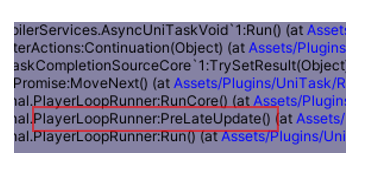
|
||||
|
||||
In default, UniTask's PlayerLoop is initialized at `[RuntimeInitializeOnLoadMethod(RuntimeInitializeLoadType.BeforeSceneLoad)]`.
|
||||
By default, UniTask's PlayerLoop is initialized at `[RuntimeInitializeOnLoadMethod(RuntimeInitializeLoadType.BeforeSceneLoad)]`.
|
||||
|
||||
The order in which methods are called in BeforeSceneLoad is indeterminate, so if you want to use UniTask in other BeforeSceneLoad methods, you should try to initialize it before this.
|
||||
The order in which methods are called in BeforeSceneLoad is nondeterministic, so if you want to use UniTask in other BeforeSceneLoad methods, you should try to initialize it before this.
|
||||
|
||||
```csharp
|
||||
// AfterAssembliesLoaded is called before BeforeSceneLoad
|
||||
@@ -386,9 +386,9 @@ public static void InitUniTaskLoop()
|
||||
}
|
||||
```
|
||||
|
||||
If you import Unity's `Entities` package, that reset custom player loop to default at `BeforeSceneLoad` and inject ECS's loop. When Unity call ECS's inject method after UniTask's initialize method, UniTask will no longer work.
|
||||
If you import Unity's `Entities` package, that resets the custom player loop to default at `BeforeSceneLoad` and injects ECS's loop. When Unity calls ECS's inject method after UniTask's initialize method, UniTask will no longer work.
|
||||
|
||||
To solve this issue, you can re-initialize UniTask PlayerLoop after ECS initialized.
|
||||
To solve this issue, you can re-initialize the UniTask PlayerLoop after ECS is initialized.
|
||||
|
||||
```csharp
|
||||
// Get ECS Loop.
|
||||
@@ -398,7 +398,7 @@ var playerLoop = ScriptBehaviourUpdateOrder.CurrentPlayerLoop;
|
||||
PlayerLoopHelper.Initialize(ref playerLoop);
|
||||
```
|
||||
|
||||
You can diagnostic UniTask's player loop is ready by `PlayerLoopHelper.IsInjectedUniTaskPlayerLoop()`. And also `PlayerLoopHelper.DumpCurrentPlayerLoop` shows current all playerloop to console.
|
||||
You can diagnose whether UniTask's player loop is ready by calling `PlayerLoopHelper.IsInjectedUniTaskPlayerLoop()`. And also `PlayerLoopHelper.DumpCurrentPlayerLoop` logs all current playerloops to console.
|
||||
|
||||
```csharp
|
||||
void Start()
|
||||
@@ -410,7 +410,7 @@ void Start()
|
||||
|
||||
async void vs async UniTaskVoid
|
||||
---
|
||||
`async void` is a standard C# task system so does not run on UniTask systems. It is better not to use. `async UniTaskVoid` is a lightweight version of `async UniTask` because it does not have awaitable completion and report error immediately to `UniTaskScheduler.UnobservedTaskException`. If you don't require to await it(fire and forget), use `UniTaskVoid` is better. Unfortunately to dismiss warning, require to using with `Forget()`.
|
||||
`async void` is a standard C# task system so it does not run on UniTask systems. It is better not to use it. `async UniTaskVoid` is a lightweight version of `async UniTask` because it does not have awaitable completion and reports errors immediately to `UniTaskScheduler.UnobservedTaskException`. If you don't require awaiting (fire and forget), using `UniTaskVoid` is better. Unfortunately to dismiss warning, you're required to call `Forget()`.
|
||||
|
||||
```csharp
|
||||
public async UniTaskVoid FireAndForgetMethod()
|
||||
@@ -425,7 +425,7 @@ public void Caller()
|
||||
}
|
||||
```
|
||||
|
||||
Also UniTask have `Forget` method, it is similar with UniTaskVoid and same effects with it. However still UniTaskVoid is more efficient if completely do not use await。
|
||||
Also UniTask has the `Forget` method, it is similar to `UniTaskVoid` and has the same effects. However `UniTaskVoid` is more efficient if you completely don't use `await`。
|
||||
|
||||
```csharp
|
||||
public async UniTask DoAsync()
|
||||
@@ -440,7 +440,7 @@ public void Caller()
|
||||
}
|
||||
```
|
||||
|
||||
Using async lambda in register event, it is used `async void`. To avoid it, you can use `UniTask.Action` or `UniTask.UnityAction` that creates delegate via `async UniTaskVoid` lambda.
|
||||
To use an async lambda registered to an event, don't use `async void`. Instead you can use `UniTask.Action` or `UniTask.UnityAction`, both of which create a delegate via `async UniTaskVoid` lambda.
|
||||
|
||||
```csharp
|
||||
Action actEvent;
|
||||
@@ -455,7 +455,7 @@ actEvent += UniTask.Action(async () => { await UniTask.Yield(); });
|
||||
unityEvent += UniTask.UnityAction(async () => { await UniTask.Yield(); });
|
||||
```
|
||||
|
||||
`UniTaskVoid` can also use in MonoBehaviour's `Start` method.
|
||||
`UniTaskVoid` can also be used in MonoBehaviour's `Start` method.
|
||||
|
||||
```csharp
|
||||
class Sample : MonoBehaviour
|
||||
@@ -469,7 +469,7 @@ class Sample : MonoBehaviour
|
||||
|
||||
UniTaskTracker
|
||||
---
|
||||
useful for check(leak) UniTasks. You can open tracker window in `Window -> UniTask Tracker`.
|
||||
useful for checking (leaked) UniTasks. You can open tracker window in `Window -> UniTask Tracker`.
|
||||
|
||||
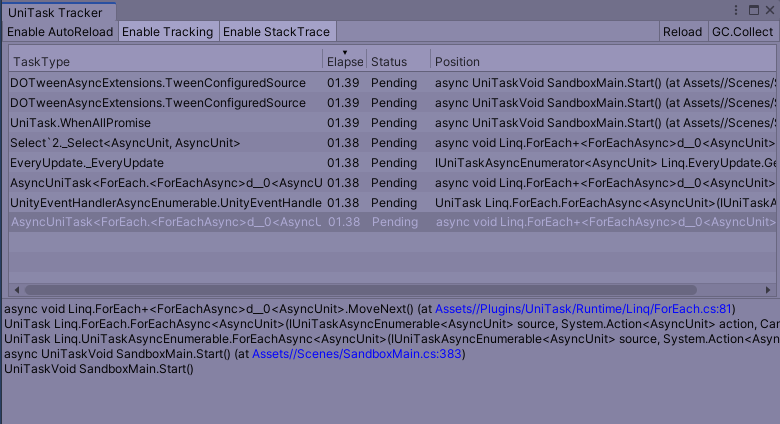
|
||||
|
||||
@@ -479,15 +479,15 @@ useful for check(leak) UniTasks. You can open tracker window in `Window -> UniTa
|
||||
* Enable Tracking(Toggle) - Start to track async/await UniTask. Performance impact: low.
|
||||
* Enable StackTrace(Toggle) - Capture StackTrace when task is started. Performance impact: high.
|
||||
|
||||
For debug use, enable tracking and capture stacktrace is useful but it it decline performance. Recommended usage is enable both to find task leak, and when done, finally disable both.
|
||||
UniTaskTracker is intended for debugging use only as enabling tracking and capturing stacktraces is useful but has a heavy performance impact. Recommended usage is to enable both tracking and stacktraces to find task leaks and to disable them both when done.
|
||||
|
||||
External Assets
|
||||
---
|
||||
In default, UniTask supports TextMeshPro(`BindTo(TMP_Text)` and `TMP_InputField` event extensions like standard uGUI `InputField`), DOTween(`Tween` as awaitable) and Addressables(`AsyncOperationHandle` and `AsyncOpereationHandle<T>` as awaitable).
|
||||
By default, UniTask supports TextMeshPro(`BindTo(TMP_Text)` and `TMP_InputField` event extensions like standard uGUI `InputField`), DOTween(`Tween` as awaitable) and Addressables(`AsyncOperationHandle` and `AsyncOperationHandle<T>` as awaitable).
|
||||
|
||||
There are defined in separated asmdef like `UniTask.TextMeshPro`, `UniTask.DOTween`, `UniTask.Addressables`.
|
||||
There are defined in separated asmdefs like `UniTask.TextMeshPro`, `UniTask.DOTween`, `UniTask.Addressables`.
|
||||
|
||||
TextMeshPro and Addressables support are automatically enabled when import there package from package manager. However DOTween support, require to `com.demigiant.dotween` import from [OpenUPM](https://openupm.com/packages/com.demigiant.dotween/) or define `UNITASK_DOTWEEN_SUPPORT` to enable it.
|
||||
TextMeshPro and Addressables support are automatically enabled when importing their packages from package manager. However for DOTween support, it is required to import `com.demigiant.dotween` from [OpenUPM](https://openupm.com/packages/com.demigiant.dotween/) or to define `UNITASK_DOTWEEN_SUPPORT` to enable it.
|
||||
|
||||
```csharp
|
||||
// sequential
|
||||
@@ -502,11 +502,11 @@ await UniTask.WhenAll(
|
||||
transform.DOScale(10, 3).WithCancellation(ct));
|
||||
```
|
||||
|
||||
DOTween support's default behaviour(`await`, `WithCancellation`, `ToUniTask`) awaits tween is killed. It works both Complete(true/false) and Kill(true/false). But if you want to tween reuse(`SetAutoKill(false)`), it does not work you expected. Or, if you want to await for another timing, the following extension methods exist in Tween, `AwaitForComplete`, `AwaitForPause`, `AwaitForPlay`, `AwaitForRewind`, `AwaitForStepComplete`.
|
||||
DOTween support's default behaviour(`await`, `WithCancellation`, `ToUniTask`) awaits tween is killed. It works on both Complete(true/false) and Kill(true/false). But if you want to reuse tweens (`SetAutoKill(false)`), it does not work as expected. If you want to await for another timing, the following extension methods exist in Tween, `AwaitForComplete`, `AwaitForPause`, `AwaitForPlay`, `AwaitForRewind`, `AwaitForStepComplete`.
|
||||
|
||||
AsyncEnumerable and Async LINQ
|
||||
---
|
||||
Unity 2020.2 supports C# 8.0 so you can use `await foreach`. This is the new Update notation in async era.
|
||||
Unity 2020.2 supports C# 8.0 so you can use `await foreach`. This is the new Update notation in the async era.
|
||||
|
||||
```csharp
|
||||
// Unity 2020.2, C# 8.0
|
||||
@@ -534,7 +534,7 @@ await okButton.OnClickAsAsyncEnumerable().Where((x, i) => i % 2 == 0).ForEachAsy
|
||||
});
|
||||
```
|
||||
|
||||
Fire and Forget style(for example, event handling), also you can use `Subscribe`.
|
||||
Fire and Forget style(for example, event handling), you can also use `Subscribe`.
|
||||
|
||||
```csharp
|
||||
okButton.OnClickAsAsyncEnumerable().Where((x, i) => i % 2 == 0).Subscribe(_ =>
|
||||
@@ -558,7 +558,7 @@ SelectAwaitWithCancellation(Func<T, CancellationToken, UniTask<TR>> selector)
|
||||
|
||||
If you want to use the `async` method inside the func, use the `***Await` or `***AwaitWithCancellation`.
|
||||
|
||||
How to create async iterator, C# 8.0 supports async iterator(`async yield return`) but it only allows `IAsyncEnumerable<T>` and of course requires C# 8.0. UniTask supports `UniTaskAsyncEnumerable.Create` method to create custom async iterator.
|
||||
How to create an async iterator: C# 8.0 supports async iterator(`async yield return`) but it only allows `IAsyncEnumerable<T>` and of course requires C# 8.0. UniTask supports `UniTaskAsyncEnumerable.Create` method to create custom async iterator.
|
||||
|
||||
```csharp
|
||||
// IAsyncEnumerable, C# 8.0 version of async iterator. ( do not use this style, IAsyncEnumerable is not controled in UniTask).
|
||||
@@ -634,7 +634,7 @@ async UniTask TripleClick(CancellationToken token)
|
||||
}
|
||||
```
|
||||
|
||||
All MonoBehaviour message events can convert async-streams by `AsyncTriggers` that can enable by `using Cysharp.Threading.Tasks.Triggers;`.
|
||||
All MonoBehaviour message events can convert async-streams by `AsyncTriggers` that can be enabled by `using Cysharp.Threading.Tasks.Triggers;`.
|
||||
|
||||
```csharp
|
||||
using Cysharp.Threading.Tasks.Triggers;
|
||||
@@ -650,7 +650,7 @@ async UniTaskVoid MonitorCollision()
|
||||
}
|
||||
```
|
||||
|
||||
Similar as uGUI event, AsyncTrigger can get by `GetAsync***Trigger` and trigger it self is UniTaskAsyncEnumerable.
|
||||
Similar to uGUI event, AsyncTrigger can be created using `GetAsync***Trigger` and triggers itself as UniTaskAsyncEnumerable.
|
||||
|
||||
```csharp
|
||||
// use await multiple times, get AsyncTriggerHandler is more efficient.
|
||||
@@ -667,7 +667,7 @@ await this.GetAsyncMoveTrigger().ForEachAsync(axisEventData =>
|
||||
});
|
||||
```
|
||||
|
||||
`AsyncReactiveProperty`, `AsyncReadOnlyReactiveProperty` is UniTask version of UniTask's ReactiveProperty. `BindTo` extension method of `IUniTaskAsyncEnumerable<T>` for binding asynchronous stream values to Unity components(Text/Selectable/TMP/Text).
|
||||
`AsyncReactiveProperty`, `AsyncReadOnlyReactiveProperty` is UniTask's version of ReactiveProperty. `BindTo` extension method of `IUniTaskAsyncEnumerable<T>` for binding asynchronous stream values to Unity components(Text/Selectable/TMP/Text).
|
||||
|
||||
```csharp
|
||||
var rp = new AsyncReactiveProperty<int>(99);
|
||||
@@ -702,9 +702,9 @@ await button.OnClickAsAsyncEnumerable().ForEachAwaitAsync(async x =>
|
||||
});
|
||||
```
|
||||
|
||||
It is useful(prevent double-click) but not useful in sometimes.
|
||||
It is useful (prevent double-click) but not useful sometimes.
|
||||
|
||||
Using `Queue()` method, which will also queue events during asynchronous processing.
|
||||
Using the `Queue()` method will also queue events during asynchronous processing.
|
||||
|
||||
```csharp
|
||||
// queued message in asynchronous processing
|
||||
@@ -725,13 +725,13 @@ button.OnClickAsAsyncEnumerable().Subscribe(async x =>
|
||||
|
||||
Channel
|
||||
---
|
||||
`Channel` is same as [System.Threading.Tasks.Channels](https://docs.microsoft.com/ja-jp/dotnet/api/system.threading.channels?view=netcore-3.1) that is similar as GoLang Channel.
|
||||
`Channel` is the same as [System.Threading.Tasks.Channels](https://docs.microsoft.com/ja-jp/dotnet/api/system.threading.channels?view=netcore-3.1) which is similar to a GoLang Channel.
|
||||
|
||||
Currently only supports multiple-producer, single-consumer unbounded channel. It can create by `Channel.CreateSingleConsumerUnbounded<T>()`.
|
||||
Currently it only supports multiple-producer, single-consumer unbounded channels. It can create by `Channel.CreateSingleConsumerUnbounded<T>()`.
|
||||
|
||||
For producer(`.Writer`), `TryWrite` to push value and `TryComplete` to complete channel. For consumer(`.Reader`), `TryRead`, `WaitToReadAsync`, `ReadAsync`, `Completion` and `ReadAllAsync` to read queued messages.
|
||||
For producer(`.Writer`), use `TryWrite` to push value and `TryComplete` to complete channel. For consumer(`.Reader`), use `TryRead`, `WaitToReadAsync`, `ReadAsync`, `Completion` and `ReadAllAsync` to read queued messages.
|
||||
|
||||
`ReadAllAsync` returns `IUniTaskAsyncEnumerable<T>` so query LINQ operators. Reader only allows single-consumer but use `.Publish()` query operator to enable multicast message. For example, make pub/sub utility.
|
||||
`ReadAllAsync` returns `IUniTaskAsyncEnumerable<T>` so query LINQ operators. Reader only allows single-consumer but uses `.Publish()` query operator to enable multicast message. For example, make pub/sub utility.
|
||||
|
||||
```csharp
|
||||
public class AsyncMessageBroker<T> : IDisposable
|
||||
@@ -768,7 +768,7 @@ public class AsyncMessageBroker<T> : IDisposable
|
||||
|
||||
For Unit Testing
|
||||
---
|
||||
Unity's `[UnityTest]` attribute can test coroutine(IEnumerator) but can not test async. `UniTask.ToCoroutine` bridges async/await to coroutine so you can test async method.
|
||||
Unity's `[UnityTest]` attribute can test coroutine(IEnumerator) but can not test async. `UniTask.ToCoroutine` bridges async/await to coroutine so you can test async methods.
|
||||
|
||||
```csharp
|
||||
[UnityTest]
|
||||
@@ -791,33 +791,33 @@ public IEnumerator DelayIgnore() => UniTask.ToCoroutine(async () =>
|
||||
});
|
||||
```
|
||||
|
||||
UniTask itself's unit test is written by Unity Test Runner and [Cysharp/RuntimeUnitTestToolkit](https://github.com/Cysharp/RuntimeUnitTestToolkit) to check on CI and IL2CPP working.
|
||||
UniTask's own unit tests are written using Unity Test Runner and [Cysharp/RuntimeUnitTestToolkit](https://github.com/Cysharp/RuntimeUnitTestToolkit) to integrate with CI and check if IL2CPP is working.
|
||||
|
||||
ThreadPool limitation
|
||||
---
|
||||
Most UniTask methods run in a single thread (PlayerLoop), but only `UniTask.Run` and `UniTask.SwitchToThreadPool` run on a thread pool. If you use a thread pool, it won't work with WebGL and so on.
|
||||
Most UniTask methods run on a single thread (PlayerLoop), with only `UniTask.Run` and `UniTask.SwitchToThreadPool` running on a thread pool. If you use a thread pool, it won't work with WebGL and so on.
|
||||
|
||||
`UniTask.Run` will be deprecated in the future (marked with an Obsolete) and only `RunOnThreadPool` will be used. Also, if you use `UniTask.Run`, consider whether you can use `UniTask.Create` or `UniTask.Void`.
|
||||
`UniTask.Run` will be deprecated in the future (marked with an Obsolete) and only `RunOnThreadPool` will be used. If you use `UniTask.Run`, consider whether you can use `UniTask.Create` or `UniTask.Void`.
|
||||
|
||||
IEnumerator.ToUniTask limitation
|
||||
---
|
||||
You can convert coroutine(IEnumerator) to UniTask(or await directly) but has some limitations.
|
||||
You can convert coroutine(IEnumerator) to UniTask(or await directly) but it has some limitations.
|
||||
|
||||
* `WaitForEndOfFrame`/`WaitForFixedUpdate`/`Coroutine` is not supported.
|
||||
* Consuming loop timing is not same as StartCoroutine, it is used specified PlayerLoopTiming, and default's `PlayerLoopTiming.Update` is run before MonoBehaviour's Update and StartCoroutine's loop.
|
||||
* Consuming loop timing is not the same as `StartCoroutine`, it uses the specified `PlayerLoopTiming` and the default `PlayerLoopTiming.Update` is run before MonoBehaviour's `Update` and `StartCoroutine`'s loop.
|
||||
|
||||
If you want to convert fully compatible from coroutine to async, use `IEnumerator.ToUniTask(MonoBehaviour coroutineRunner)` overload. It executes StartCoroutine on an instance of the argument MonoBehaviour and waits for it to complete in UniTask.
|
||||
If you want fully compatible conversion from coroutine to async, use the `IEnumerator.ToUniTask(MonoBehaviour coroutineRunner)` overload. It executes StartCoroutine on an instance of the argument MonoBehaviour and waits for it to complete in UniTask.
|
||||
|
||||
For UnityEditor
|
||||
---
|
||||
UniTask can run on Unity Edtitor like Editor Coroutine. However, there are some limitations.
|
||||
UniTask can run on Unity Editor like an Editor Coroutine. However, there are some limitations.
|
||||
|
||||
* Delay, DelayFrame is not work correctly because can not get deltaTime in editor. Return the result of the await immediately; you can use `DelayType.Realtime` to wait for the right time.
|
||||
* All PlayerLoopTiming run on timing, `EditorApplication.update`.
|
||||
* Delay, DelayFrame do not work correctly because they can not get deltaTime in editor. Return the result of the await immediately; you can use `DelayType.Realtime` to wait for the right time.
|
||||
* All PlayerLoopTiming run on the timing `EditorApplication.update`.
|
||||
|
||||
Compare with Standard Task API
|
||||
---
|
||||
UniTask has many standard Task-like APIs. This table shows what is the alternative apis.
|
||||
UniTask has many standard Task-like APIs. This table shows what the alternative apis are.
|
||||
|
||||
Use standard type.
|
||||
|
||||
@@ -863,7 +863,7 @@ Use UniTask type.
|
||||
|
||||
Pooling Configuration
|
||||
---
|
||||
UniTask is aggressively caching async promise object to achive zero allocation(technical details, see blog post [UniTask v2 — Zero Allocation async/await for Unity, with Asynchronous LINQ](https://medium.com/@neuecc/unitask-v2-zero-allocation-async-await-for-unity-with-asynchronous-linq-1aa9c96aa7dd)). In default, cache all promises but you can configure `TaskPool.SetMaxPoolSize` to your value, the value indicates cache size per type. `TaskPool.GetCacheSizeInfo` returns current cached object in pool.
|
||||
UniTask aggressively caches async promise objects to achieve zero allocation (for technical details, see blog post [UniTask v2 — Zero Allocation async/await for Unity, with Asynchronous LINQ](https://medium.com/@neuecc/unitask-v2-zero-allocation-async-await-for-unity-with-asynchronous-linq-1aa9c96aa7dd)). By default, it caches all promises but you can configure `TaskPool.SetMaxPoolSize` to your value, the value indicates cache size per type. `TaskPool.GetCacheSizeInfo` returns currently cached objects in pool.
|
||||
|
||||
```csharp
|
||||
foreach (var (type, size) in TaskPool.GetCacheSizeInfo())
|
||||
@@ -874,17 +874,17 @@ foreach (var (type, size) in TaskPool.GetCacheSizeInfo())
|
||||
|
||||
Allocation on Profiler
|
||||
---
|
||||
In UnityEditor profiler shows allocation of compiler generated AsyncStateMachine but it only occurs in debug(development) build. C# Compiler generate AsyncStateMachine as class on Debug build and as struct on Release build.
|
||||
In UnityEditor the profiler shows allocation of compiler generated AsyncStateMachine but it only occurs in debug(development) build. C# Compiler generates AsyncStateMachine as class on Debug build and as struct on Release build.
|
||||
|
||||
After Unity 2020.1 supports Code Optimization option on UnityEditor(right, footer).
|
||||
Unity supports Code Optimization option starting in 2020.1 (right, footer).
|
||||
|
||||

|
||||
|
||||
You can change C# compiler optimization to release, it removes AsyncStateMachine allocation. Andalso optimization option can set via `Compilation.CompilationPipeline-codeOptimization`, and `Compilation.CodeOptimization`.
|
||||
You can change C# compiler optimization to release to remove AsyncStateMachine allocation in development builds. This optimization option can also be set via `Compilation.CompilationPipeline-codeOptimization`, and `Compilation.CodeOptimization`.
|
||||
|
||||
UniTaskSynchronizationContext
|
||||
---
|
||||
Unity's default SynchronizationContext(`UnitySynchronizationContext`) is poor implementation for performance. UniTask itself is bypass `SynchronizationContext`(and `ExecutionContext`) so does not use it but if exists in `async Task`, still used it. `UniTaskSynchronizationContext` is replacement of `UnitySynchronizationContext`, it is better for performance.
|
||||
Unity's default SynchronizationContext(`UnitySynchronizationContext`) is a poor implementation for performance. UniTask bypasses `SynchronizationContext`(and `ExecutionContext`) so it does not use it but if exists in `async Task`, still used it. `UniTaskSynchronizationContext` is a replacement of `UnitySynchronizationContext` which is better for performance.
|
||||
|
||||
```csharp
|
||||
public class SyncContextInjecter
|
||||
@@ -897,19 +897,19 @@ public class SyncContextInjecter
|
||||
}
|
||||
```
|
||||
|
||||
This is an optional choice and is not always recommended; `UniTaskSynchronizationContext` is less performance than `async UniTask` and is not a complete UniTask replacement. It also does not guarantee full behavioral compatibility with the `UnitySynchronizationContext`.
|
||||
This is an optional choice and is not always recommended; `UniTaskSynchronizationContext` is less performant than `async UniTask` and is not a complete UniTask replacement. It also does not guarantee full behavioral compatibility with the `UnitySynchronizationContext`.
|
||||
|
||||
API References
|
||||
---
|
||||
UniTask's API References is hosted at [cysharp.github.io/UniTask](https://cysharp.github.io/UniTask/api/Cysharp.Threading.Tasks.html) by [DocFX](https://dotnet.github.io/docfx/) and [Cysharp/DocfXTemplate](https://github.com/Cysharp/DocfxTemplate).
|
||||
UniTask's API References are hosted at [cysharp.github.io/UniTask](https://cysharp.github.io/UniTask/api/Cysharp.Threading.Tasks.html) by [DocFX](https://dotnet.github.io/docfx/) and [Cysharp/DocfXTemplate](https://github.com/Cysharp/DocfxTemplate).
|
||||
|
||||
For example, UniTask's factory methods can see at [UniTask#methods](https://cysharp.github.io/UniTask/api/Cysharp.Threading.Tasks.UniTask.html#methods-1). UniTaskAsyncEnumerable's factory/extension methods can see at [UniTaskAsyncEnumerable#methods](https://cysharp.github.io/UniTask/api/Cysharp.Threading.Tasks.Linq.UniTaskAsyncEnumerable.html#methods-1).
|
||||
For example, UniTask's factory methods can be seen at [UniTask#methods](https://cysharp.github.io/UniTask/api/Cysharp.Threading.Tasks.UniTask.html#methods-1). UniTaskAsyncEnumerable's factory/extension methods can be seen at [UniTaskAsyncEnumerable#methods](https://cysharp.github.io/UniTask/api/Cysharp.Threading.Tasks.Linq.UniTaskAsyncEnumerable.html#methods-1).
|
||||
|
||||
UPM Package
|
||||
---
|
||||
### Install via git URL
|
||||
|
||||
After Unity 2019.3.4f1, Unity 2020.1a21, that support path query parameter of git package. You can add `https://github.com/Cysharp/UniTask.git?path=src/UniTask/Assets/Plugins/UniTask` to Package Manager
|
||||
Requires a version of unity that supports path query parameter for git packages (Unity >= 2019.3.4f1, Unity >= 2020.1a21). You can add `https://github.com/Cysharp/UniTask.git?path=src/UniTask/Assets/Plugins/UniTask` to Package Manager
|
||||
|
||||

|
||||
|
||||
@@ -917,7 +917,7 @@ After Unity 2019.3.4f1, Unity 2020.1a21, that support path query parameter of gi
|
||||
|
||||
or add `"com.cysharp.unitask": "https://github.com/Cysharp/UniTask.git?path=src/UniTask/Assets/Plugins/UniTask"` to `Packages/manifest.json`.
|
||||
|
||||
If you want to set a target version, UniTask is using `*.*.*` release tag so you can specify a version like `#2.1.0`. For example `https://github.com/Cysharp/UniTask.git?path=src/UniTask/Assets/Plugins/UniTask#2.1.0`.
|
||||
If you want to set a target version, UniTask uses the `*.*.*` release tag so you can specify a version like `#2.1.0`. For example `https://github.com/Cysharp/UniTask.git?path=src/UniTask/Assets/Plugins/UniTask#2.1.0`.
|
||||
|
||||
### Install via OpenUPM
|
||||
|
||||
@@ -933,11 +933,11 @@ For .NET Core, use NuGet.
|
||||
|
||||
> PM> Install-Package [UniTask](https://www.nuget.org/packages/UniTask)
|
||||
|
||||
UniTask of .NET Core version is a subset of Unity UniTask, removed PlayerLoop dependent methods.
|
||||
UniTask of .NET Core version is a subset of Unity UniTask with PlayerLoop dependent methods removed.
|
||||
|
||||
It runs at higher performance than the standard Task/ValueTask, but you should be careful to ignore the ExecutionContext/SynchronizationContext when using it. `AysncLocal` also does not work because it ignores ExecutionContext.
|
||||
|
||||
If you use UniTask internally, but provide ValueTask as an external API, you can write like the following(Inspired by [PooledAwait](https://github.com/mgravell/PooledAwait)).
|
||||
If you use UniTask internally, but provide ValueTask as an external API, you can write it like the following(Inspired by [PooledAwait](https://github.com/mgravell/PooledAwait)).
|
||||
|
||||
```csharp
|
||||
public class ZeroAllocAsyncAwaitInDotNetCore
|
||||
@@ -970,7 +970,7 @@ public ValueTask TestAsync()
|
||||
|
||||
.NET Core version is intended to allow users to use UniTask as an interface when sharing code with Unity (such as [Cysharp/MagicOnion](https://github.com/Cysharp/MagicOnion/)). .NET Core version of UniTask enables smooth code sharing.
|
||||
|
||||
Utility methods such as WhenAll which is equivalent to UniTask are provided as [Cysharp/ValueTaskSupplement](https://github.com/Cysharp/ValueTaskSupplement).
|
||||
Utility methods such as WhenAll which are equivalent to UniTask are provided as [Cysharp/ValueTaskSupplement](https://github.com/Cysharp/ValueTaskSupplement).
|
||||
|
||||
License
|
||||
---
|
||||
|
||||
@@ -20,8 +20,9 @@ public static class EditorRunnerChecker
|
||||
{
|
||||
Debug.Log("Start");
|
||||
|
||||
var r = await UnityWebRequest.Get("https://bing.com/").SendWebRequest().ToUniTask();
|
||||
Debug.Log(r.downloadHandler.text.Substring(0, 100));
|
||||
//var r = await UnityWebRequest.Get("https://bing.com/").SendWebRequest().ToUniTask();
|
||||
//Debug.Log(r.downloadHandler.text.Substring(0, 100));
|
||||
await UniTask.Yield();
|
||||
|
||||
Debug.Log("End");
|
||||
}
|
||||
|
||||
@@ -7,6 +7,8 @@ using UnityEngine.Networking;
|
||||
|
||||
namespace Cysharp.Threading.Tasks.Internal
|
||||
{
|
||||
#if ENABLE_UNITYWEBREQUEST && (!UNITY_2019_1_OR_NEWER || UNITASK_WEBREQUEST_SUPPORT)
|
||||
|
||||
internal static class UnityWebRequestResultExtensions
|
||||
{
|
||||
public static bool IsError(this UnityWebRequest unityWebRequest)
|
||||
@@ -21,4 +23,6 @@ namespace Cysharp.Threading.Tasks.Internal
|
||||
#endif
|
||||
}
|
||||
}
|
||||
|
||||
#endif
|
||||
}
|
||||
@@ -2,7 +2,9 @@
|
||||
|
||||
using System.Threading;
|
||||
using UnityEngine;
|
||||
#if !UNITY_2019_1_OR_NEWER || UNITASK_UGUI_SUPPORT
|
||||
using UnityEngine.EventSystems;
|
||||
#endif
|
||||
|
||||
namespace Cysharp.Threading.Tasks.Triggers
|
||||
{
|
||||
@@ -715,6 +717,7 @@ namespace Cysharp.Threading.Tasks.Triggers
|
||||
#endregion
|
||||
|
||||
#region CollisionEnter
|
||||
#if !UNITY_2019_1_OR_NEWER || UNITASK_PHYSICS_SUPPORT
|
||||
|
||||
public interface IAsyncOnCollisionEnterHandler
|
||||
{
|
||||
@@ -771,9 +774,11 @@ namespace Cysharp.Threading.Tasks.Triggers
|
||||
return ((IAsyncOnCollisionEnterHandler)new AsyncTriggerHandler<Collision>(this, cancellationToken, true)).OnCollisionEnterAsync();
|
||||
}
|
||||
}
|
||||
#endif
|
||||
#endregion
|
||||
|
||||
#region CollisionEnter2D
|
||||
#if !UNITY_2019_1_OR_NEWER || UNITASK_PHYSICS2D_SUPPORT
|
||||
|
||||
public interface IAsyncOnCollisionEnter2DHandler
|
||||
{
|
||||
@@ -830,9 +835,11 @@ namespace Cysharp.Threading.Tasks.Triggers
|
||||
return ((IAsyncOnCollisionEnter2DHandler)new AsyncTriggerHandler<Collision2D>(this, cancellationToken, true)).OnCollisionEnter2DAsync();
|
||||
}
|
||||
}
|
||||
#endif
|
||||
#endregion
|
||||
|
||||
#region CollisionExit
|
||||
#if !UNITY_2019_1_OR_NEWER || UNITASK_PHYSICS_SUPPORT
|
||||
|
||||
public interface IAsyncOnCollisionExitHandler
|
||||
{
|
||||
@@ -889,9 +896,11 @@ namespace Cysharp.Threading.Tasks.Triggers
|
||||
return ((IAsyncOnCollisionExitHandler)new AsyncTriggerHandler<Collision>(this, cancellationToken, true)).OnCollisionExitAsync();
|
||||
}
|
||||
}
|
||||
#endif
|
||||
#endregion
|
||||
|
||||
#region CollisionExit2D
|
||||
#if !UNITY_2019_1_OR_NEWER || UNITASK_PHYSICS2D_SUPPORT
|
||||
|
||||
public interface IAsyncOnCollisionExit2DHandler
|
||||
{
|
||||
@@ -948,9 +957,11 @@ namespace Cysharp.Threading.Tasks.Triggers
|
||||
return ((IAsyncOnCollisionExit2DHandler)new AsyncTriggerHandler<Collision2D>(this, cancellationToken, true)).OnCollisionExit2DAsync();
|
||||
}
|
||||
}
|
||||
#endif
|
||||
#endregion
|
||||
|
||||
#region CollisionStay
|
||||
#if !UNITY_2019_1_OR_NEWER || UNITASK_PHYSICS_SUPPORT
|
||||
|
||||
public interface IAsyncOnCollisionStayHandler
|
||||
{
|
||||
@@ -1007,9 +1018,11 @@ namespace Cysharp.Threading.Tasks.Triggers
|
||||
return ((IAsyncOnCollisionStayHandler)new AsyncTriggerHandler<Collision>(this, cancellationToken, true)).OnCollisionStayAsync();
|
||||
}
|
||||
}
|
||||
#endif
|
||||
#endregion
|
||||
|
||||
#region CollisionStay2D
|
||||
#if !UNITY_2019_1_OR_NEWER || UNITASK_PHYSICS2D_SUPPORT
|
||||
|
||||
public interface IAsyncOnCollisionStay2DHandler
|
||||
{
|
||||
@@ -1066,9 +1079,11 @@ namespace Cysharp.Threading.Tasks.Triggers
|
||||
return ((IAsyncOnCollisionStay2DHandler)new AsyncTriggerHandler<Collision2D>(this, cancellationToken, true)).OnCollisionStay2DAsync();
|
||||
}
|
||||
}
|
||||
#endif
|
||||
#endregion
|
||||
|
||||
#region ControllerColliderHit
|
||||
#if !UNITY_2019_1_OR_NEWER || UNITASK_PHYSICS_SUPPORT
|
||||
|
||||
public interface IAsyncOnControllerColliderHitHandler
|
||||
{
|
||||
@@ -1125,6 +1140,7 @@ namespace Cysharp.Threading.Tasks.Triggers
|
||||
return ((IAsyncOnControllerColliderHitHandler)new AsyncTriggerHandler<ControllerColliderHit>(this, cancellationToken, true)).OnControllerColliderHitAsync();
|
||||
}
|
||||
}
|
||||
#endif
|
||||
#endregion
|
||||
|
||||
#region Disable
|
||||
@@ -1423,6 +1439,7 @@ namespace Cysharp.Threading.Tasks.Triggers
|
||||
#endregion
|
||||
|
||||
#region JointBreak
|
||||
#if !UNITY_2019_1_OR_NEWER || UNITASK_PHYSICS_SUPPORT
|
||||
|
||||
public interface IAsyncOnJointBreakHandler
|
||||
{
|
||||
@@ -1479,9 +1496,11 @@ namespace Cysharp.Threading.Tasks.Triggers
|
||||
return ((IAsyncOnJointBreakHandler)new AsyncTriggerHandler<float>(this, cancellationToken, true)).OnJointBreakAsync();
|
||||
}
|
||||
}
|
||||
#endif
|
||||
#endregion
|
||||
|
||||
#region JointBreak2D
|
||||
#if !UNITY_2019_1_OR_NEWER || UNITASK_PHYSICS2D_SUPPORT
|
||||
|
||||
public interface IAsyncOnJointBreak2DHandler
|
||||
{
|
||||
@@ -1538,6 +1557,7 @@ namespace Cysharp.Threading.Tasks.Triggers
|
||||
return ((IAsyncOnJointBreak2DHandler)new AsyncTriggerHandler<Joint2D>(this, cancellationToken, true)).OnJointBreak2DAsync();
|
||||
}
|
||||
}
|
||||
#endif
|
||||
#endregion
|
||||
|
||||
#region MouseDown
|
||||
@@ -2145,7 +2165,7 @@ namespace Cysharp.Threading.Tasks.Triggers
|
||||
#endregion
|
||||
|
||||
#region ParticleUpdateJobScheduled
|
||||
#if UNITY_2019_3_OR_NEWER
|
||||
#if UNITY_2019_3_OR_NEWER && (!UNITY_2019_1_OR_NEWER || UNITASK_PARTICLESYSTEM_SUPPORT)
|
||||
|
||||
public interface IAsyncOnParticleUpdateJobScheduledHandler
|
||||
{
|
||||
@@ -2796,6 +2816,7 @@ namespace Cysharp.Threading.Tasks.Triggers
|
||||
#endregion
|
||||
|
||||
#region TriggerEnter
|
||||
#if !UNITY_2019_1_OR_NEWER || UNITASK_PHYSICS_SUPPORT
|
||||
|
||||
public interface IAsyncOnTriggerEnterHandler
|
||||
{
|
||||
@@ -2852,9 +2873,11 @@ namespace Cysharp.Threading.Tasks.Triggers
|
||||
return ((IAsyncOnTriggerEnterHandler)new AsyncTriggerHandler<Collider>(this, cancellationToken, true)).OnTriggerEnterAsync();
|
||||
}
|
||||
}
|
||||
#endif
|
||||
#endregion
|
||||
|
||||
#region TriggerEnter2D
|
||||
#if !UNITY_2019_1_OR_NEWER || UNITASK_PHYSICS2D_SUPPORT
|
||||
|
||||
public interface IAsyncOnTriggerEnter2DHandler
|
||||
{
|
||||
@@ -2911,9 +2934,11 @@ namespace Cysharp.Threading.Tasks.Triggers
|
||||
return ((IAsyncOnTriggerEnter2DHandler)new AsyncTriggerHandler<Collider2D>(this, cancellationToken, true)).OnTriggerEnter2DAsync();
|
||||
}
|
||||
}
|
||||
#endif
|
||||
#endregion
|
||||
|
||||
#region TriggerExit
|
||||
#if !UNITY_2019_1_OR_NEWER || UNITASK_PHYSICS_SUPPORT
|
||||
|
||||
public interface IAsyncOnTriggerExitHandler
|
||||
{
|
||||
@@ -2970,9 +2995,11 @@ namespace Cysharp.Threading.Tasks.Triggers
|
||||
return ((IAsyncOnTriggerExitHandler)new AsyncTriggerHandler<Collider>(this, cancellationToken, true)).OnTriggerExitAsync();
|
||||
}
|
||||
}
|
||||
#endif
|
||||
#endregion
|
||||
|
||||
#region TriggerExit2D
|
||||
#if !UNITY_2019_1_OR_NEWER || UNITASK_PHYSICS2D_SUPPORT
|
||||
|
||||
public interface IAsyncOnTriggerExit2DHandler
|
||||
{
|
||||
@@ -3029,9 +3056,11 @@ namespace Cysharp.Threading.Tasks.Triggers
|
||||
return ((IAsyncOnTriggerExit2DHandler)new AsyncTriggerHandler<Collider2D>(this, cancellationToken, true)).OnTriggerExit2DAsync();
|
||||
}
|
||||
}
|
||||
#endif
|
||||
#endregion
|
||||
|
||||
#region TriggerStay
|
||||
#if !UNITY_2019_1_OR_NEWER || UNITASK_PHYSICS_SUPPORT
|
||||
|
||||
public interface IAsyncOnTriggerStayHandler
|
||||
{
|
||||
@@ -3088,9 +3117,11 @@ namespace Cysharp.Threading.Tasks.Triggers
|
||||
return ((IAsyncOnTriggerStayHandler)new AsyncTriggerHandler<Collider>(this, cancellationToken, true)).OnTriggerStayAsync();
|
||||
}
|
||||
}
|
||||
#endif
|
||||
#endregion
|
||||
|
||||
#region TriggerStay2D
|
||||
#if !UNITY_2019_1_OR_NEWER || UNITASK_PHYSICS2D_SUPPORT
|
||||
|
||||
public interface IAsyncOnTriggerStay2DHandler
|
||||
{
|
||||
@@ -3147,6 +3178,7 @@ namespace Cysharp.Threading.Tasks.Triggers
|
||||
return ((IAsyncOnTriggerStay2DHandler)new AsyncTriggerHandler<Collider2D>(this, cancellationToken, true)).OnTriggerStay2DAsync();
|
||||
}
|
||||
}
|
||||
#endif
|
||||
#endregion
|
||||
|
||||
#region Validate
|
||||
@@ -3386,6 +3418,7 @@ namespace Cysharp.Threading.Tasks.Triggers
|
||||
#endregion
|
||||
|
||||
#region BeginDrag
|
||||
#if !UNITY_2019_1_OR_NEWER || UNITASK_UGUI_SUPPORT
|
||||
|
||||
public interface IAsyncOnBeginDragHandler
|
||||
{
|
||||
@@ -3442,9 +3475,11 @@ namespace Cysharp.Threading.Tasks.Triggers
|
||||
return ((IAsyncOnBeginDragHandler)new AsyncTriggerHandler<PointerEventData>(this, cancellationToken, true)).OnBeginDragAsync();
|
||||
}
|
||||
}
|
||||
#endif
|
||||
#endregion
|
||||
|
||||
#region Cancel
|
||||
#if !UNITY_2019_1_OR_NEWER || UNITASK_UGUI_SUPPORT
|
||||
|
||||
public interface IAsyncOnCancelHandler
|
||||
{
|
||||
@@ -3501,9 +3536,11 @@ namespace Cysharp.Threading.Tasks.Triggers
|
||||
return ((IAsyncOnCancelHandler)new AsyncTriggerHandler<BaseEventData>(this, cancellationToken, true)).OnCancelAsync();
|
||||
}
|
||||
}
|
||||
#endif
|
||||
#endregion
|
||||
|
||||
#region Deselect
|
||||
#if !UNITY_2019_1_OR_NEWER || UNITASK_UGUI_SUPPORT
|
||||
|
||||
public interface IAsyncOnDeselectHandler
|
||||
{
|
||||
@@ -3560,9 +3597,11 @@ namespace Cysharp.Threading.Tasks.Triggers
|
||||
return ((IAsyncOnDeselectHandler)new AsyncTriggerHandler<BaseEventData>(this, cancellationToken, true)).OnDeselectAsync();
|
||||
}
|
||||
}
|
||||
#endif
|
||||
#endregion
|
||||
|
||||
#region Drag
|
||||
#if !UNITY_2019_1_OR_NEWER || UNITASK_UGUI_SUPPORT
|
||||
|
||||
public interface IAsyncOnDragHandler
|
||||
{
|
||||
@@ -3619,9 +3658,11 @@ namespace Cysharp.Threading.Tasks.Triggers
|
||||
return ((IAsyncOnDragHandler)new AsyncTriggerHandler<PointerEventData>(this, cancellationToken, true)).OnDragAsync();
|
||||
}
|
||||
}
|
||||
#endif
|
||||
#endregion
|
||||
|
||||
#region Drop
|
||||
#if !UNITY_2019_1_OR_NEWER || UNITASK_UGUI_SUPPORT
|
||||
|
||||
public interface IAsyncOnDropHandler
|
||||
{
|
||||
@@ -3678,9 +3719,11 @@ namespace Cysharp.Threading.Tasks.Triggers
|
||||
return ((IAsyncOnDropHandler)new AsyncTriggerHandler<PointerEventData>(this, cancellationToken, true)).OnDropAsync();
|
||||
}
|
||||
}
|
||||
#endif
|
||||
#endregion
|
||||
|
||||
#region EndDrag
|
||||
#if !UNITY_2019_1_OR_NEWER || UNITASK_UGUI_SUPPORT
|
||||
|
||||
public interface IAsyncOnEndDragHandler
|
||||
{
|
||||
@@ -3737,9 +3780,11 @@ namespace Cysharp.Threading.Tasks.Triggers
|
||||
return ((IAsyncOnEndDragHandler)new AsyncTriggerHandler<PointerEventData>(this, cancellationToken, true)).OnEndDragAsync();
|
||||
}
|
||||
}
|
||||
#endif
|
||||
#endregion
|
||||
|
||||
#region InitializePotentialDrag
|
||||
#if !UNITY_2019_1_OR_NEWER || UNITASK_UGUI_SUPPORT
|
||||
|
||||
public interface IAsyncOnInitializePotentialDragHandler
|
||||
{
|
||||
@@ -3796,9 +3841,11 @@ namespace Cysharp.Threading.Tasks.Triggers
|
||||
return ((IAsyncOnInitializePotentialDragHandler)new AsyncTriggerHandler<PointerEventData>(this, cancellationToken, true)).OnInitializePotentialDragAsync();
|
||||
}
|
||||
}
|
||||
#endif
|
||||
#endregion
|
||||
|
||||
#region Move
|
||||
#if !UNITY_2019_1_OR_NEWER || UNITASK_UGUI_SUPPORT
|
||||
|
||||
public interface IAsyncOnMoveHandler
|
||||
{
|
||||
@@ -3855,9 +3902,11 @@ namespace Cysharp.Threading.Tasks.Triggers
|
||||
return ((IAsyncOnMoveHandler)new AsyncTriggerHandler<AxisEventData>(this, cancellationToken, true)).OnMoveAsync();
|
||||
}
|
||||
}
|
||||
#endif
|
||||
#endregion
|
||||
|
||||
#region PointerClick
|
||||
#if !UNITY_2019_1_OR_NEWER || UNITASK_UGUI_SUPPORT
|
||||
|
||||
public interface IAsyncOnPointerClickHandler
|
||||
{
|
||||
@@ -3914,9 +3963,11 @@ namespace Cysharp.Threading.Tasks.Triggers
|
||||
return ((IAsyncOnPointerClickHandler)new AsyncTriggerHandler<PointerEventData>(this, cancellationToken, true)).OnPointerClickAsync();
|
||||
}
|
||||
}
|
||||
#endif
|
||||
#endregion
|
||||
|
||||
#region PointerDown
|
||||
#if !UNITY_2019_1_OR_NEWER || UNITASK_UGUI_SUPPORT
|
||||
|
||||
public interface IAsyncOnPointerDownHandler
|
||||
{
|
||||
@@ -3973,9 +4024,11 @@ namespace Cysharp.Threading.Tasks.Triggers
|
||||
return ((IAsyncOnPointerDownHandler)new AsyncTriggerHandler<PointerEventData>(this, cancellationToken, true)).OnPointerDownAsync();
|
||||
}
|
||||
}
|
||||
#endif
|
||||
#endregion
|
||||
|
||||
#region PointerEnter
|
||||
#if !UNITY_2019_1_OR_NEWER || UNITASK_UGUI_SUPPORT
|
||||
|
||||
public interface IAsyncOnPointerEnterHandler
|
||||
{
|
||||
@@ -4032,9 +4085,11 @@ namespace Cysharp.Threading.Tasks.Triggers
|
||||
return ((IAsyncOnPointerEnterHandler)new AsyncTriggerHandler<PointerEventData>(this, cancellationToken, true)).OnPointerEnterAsync();
|
||||
}
|
||||
}
|
||||
#endif
|
||||
#endregion
|
||||
|
||||
#region PointerExit
|
||||
#if !UNITY_2019_1_OR_NEWER || UNITASK_UGUI_SUPPORT
|
||||
|
||||
public interface IAsyncOnPointerExitHandler
|
||||
{
|
||||
@@ -4091,9 +4146,11 @@ namespace Cysharp.Threading.Tasks.Triggers
|
||||
return ((IAsyncOnPointerExitHandler)new AsyncTriggerHandler<PointerEventData>(this, cancellationToken, true)).OnPointerExitAsync();
|
||||
}
|
||||
}
|
||||
#endif
|
||||
#endregion
|
||||
|
||||
#region PointerUp
|
||||
#if !UNITY_2019_1_OR_NEWER || UNITASK_UGUI_SUPPORT
|
||||
|
||||
public interface IAsyncOnPointerUpHandler
|
||||
{
|
||||
@@ -4150,9 +4207,11 @@ namespace Cysharp.Threading.Tasks.Triggers
|
||||
return ((IAsyncOnPointerUpHandler)new AsyncTriggerHandler<PointerEventData>(this, cancellationToken, true)).OnPointerUpAsync();
|
||||
}
|
||||
}
|
||||
#endif
|
||||
#endregion
|
||||
|
||||
#region Scroll
|
||||
#if !UNITY_2019_1_OR_NEWER || UNITASK_UGUI_SUPPORT
|
||||
|
||||
public interface IAsyncOnScrollHandler
|
||||
{
|
||||
@@ -4209,9 +4268,11 @@ namespace Cysharp.Threading.Tasks.Triggers
|
||||
return ((IAsyncOnScrollHandler)new AsyncTriggerHandler<PointerEventData>(this, cancellationToken, true)).OnScrollAsync();
|
||||
}
|
||||
}
|
||||
#endif
|
||||
#endregion
|
||||
|
||||
#region Select
|
||||
#if !UNITY_2019_1_OR_NEWER || UNITASK_UGUI_SUPPORT
|
||||
|
||||
public interface IAsyncOnSelectHandler
|
||||
{
|
||||
@@ -4268,9 +4329,11 @@ namespace Cysharp.Threading.Tasks.Triggers
|
||||
return ((IAsyncOnSelectHandler)new AsyncTriggerHandler<BaseEventData>(this, cancellationToken, true)).OnSelectAsync();
|
||||
}
|
||||
}
|
||||
#endif
|
||||
#endregion
|
||||
|
||||
#region Submit
|
||||
#if !UNITY_2019_1_OR_NEWER || UNITASK_UGUI_SUPPORT
|
||||
|
||||
public interface IAsyncOnSubmitHandler
|
||||
{
|
||||
@@ -4327,9 +4390,11 @@ namespace Cysharp.Threading.Tasks.Triggers
|
||||
return ((IAsyncOnSubmitHandler)new AsyncTriggerHandler<BaseEventData>(this, cancellationToken, true)).OnSubmitAsync();
|
||||
}
|
||||
}
|
||||
#endif
|
||||
#endregion
|
||||
|
||||
#region UpdateSelected
|
||||
#if !UNITY_2019_1_OR_NEWER || UNITASK_UGUI_SUPPORT
|
||||
|
||||
public interface IAsyncOnUpdateSelectedHandler
|
||||
{
|
||||
@@ -4386,6 +4451,7 @@ namespace Cysharp.Threading.Tasks.Triggers
|
||||
return ((IAsyncOnUpdateSelectedHandler)new AsyncTriggerHandler<BaseEventData>(this, cancellationToken, true)).OnUpdateSelectedAsync();
|
||||
}
|
||||
}
|
||||
#endif
|
||||
#endregion
|
||||
|
||||
}
|
||||
@@ -106,24 +106,36 @@
|
||||
Func<(string argType, string argName)[], string> BuildMethodArgument = x => string.Join(", ", x.Select(y => y.argType + " " + y.argName));
|
||||
Func<(string argType, string argName)[], string> BuildResultParameter = x => x.Length == 0 ? "AsyncUnit.Default" : "(" + string.Join(", ", x.Select(y => y.argName)) + ")";
|
||||
|
||||
Func<string, bool> Is2019_3 = x => x == "ParticleUpdateJobScheduled";
|
||||
Func<string, bool> IsParticleSystem = x => x == "ParticleUpdateJobScheduled";
|
||||
Func<string, bool> IsMouseTrigger = x => x.StartsWith("Mouse");
|
||||
Func<string, string> RequirePhysicsModule = x => (x.StartsWith("Collision") || x.StartsWith("Collider") || x.StartsWith("ControllerCollider") || x.StartsWith("Joint") || x.StartsWith("Trigger"))
|
||||
? (x.Contains("2D") ? "UNITASK_PHYSICS2D_SUPPORT" : "UNITASK_PHYSICS_SUPPORT")
|
||||
: null;
|
||||
Func<string, bool> IsUguiSystem = x => x != null;
|
||||
#>
|
||||
#pragma warning disable CS1591 // Missing XML comment for publicly visible type or member
|
||||
|
||||
using System.Threading;
|
||||
using UnityEngine;
|
||||
#if !UNITY_2019_1_OR_NEWER || UNITASK_UGUI_SUPPORT
|
||||
using UnityEngine.EventSystems;
|
||||
#endif
|
||||
|
||||
namespace Cysharp.Threading.Tasks.Triggers
|
||||
{
|
||||
<# foreach(var t in triggers) { #>
|
||||
#region <#= t.triggerName #>
|
||||
<# if(Is2019_3(t.triggerName)) { #>
|
||||
#if UNITY_2019_3_OR_NEWER
|
||||
<# if(IsUguiSystem(t.handlerInterface)) { #>
|
||||
#if !UNITY_2019_1_OR_NEWER || UNITASK_UGUI_SUPPORT
|
||||
<# } #>
|
||||
<# if(IsParticleSystem(t.triggerName)) { #>
|
||||
#if UNITY_2019_3_OR_NEWER && (!UNITY_2019_1_OR_NEWER || UNITASK_PARTICLESYSTEM_SUPPORT)
|
||||
<# } #>
|
||||
<# if(IsMouseTrigger(t.triggerName)) { #>
|
||||
#if !(UNITY_IPHONE || UNITY_ANDROID || UNITY_METRO)
|
||||
<# } #>
|
||||
<# if(RequirePhysicsModule(t.triggerName) != null) { #>
|
||||
#if !UNITY_2019_1_OR_NEWER || <#= RequirePhysicsModule(t.triggerName) #>
|
||||
<# } #>
|
||||
|
||||
public interface <#= ToInterfaceName(t.methodName) #>
|
||||
@@ -181,7 +193,13 @@ namespace Cysharp.Threading.Tasks.Triggers
|
||||
return ((<#= ToInterfaceName(t.methodName) #>)new AsyncTriggerHandler<<#= t.returnType #>>(this, cancellationToken, true)).<#= t.methodName #>Async();
|
||||
}
|
||||
}
|
||||
<# if(Is2019_3(t.triggerName) || IsMouseTrigger(t.triggerName)) { #>
|
||||
<# if(IsUguiSystem(t.handlerInterface)) { #>
|
||||
#endif
|
||||
<# } #>
|
||||
<# if(RequirePhysicsModule(t.triggerName) != null) { #>
|
||||
#endif
|
||||
<# } #>
|
||||
<# if(IsParticleSystem(t.triggerName) || IsMouseTrigger(t.triggerName)) { #>
|
||||
#endif
|
||||
<# } #>
|
||||
#endregion
|
||||
|
||||
@@ -1,7 +1,7 @@
|
||||
{
|
||||
"name": "UniTask",
|
||||
"references": [
|
||||
],
|
||||
"rootNamespace": "",
|
||||
"references": [],
|
||||
"includePlatforms": [],
|
||||
"excludePlatforms": [],
|
||||
"allowUnsafeCode": false,
|
||||
@@ -14,6 +14,31 @@
|
||||
"name": "com.unity.modules.assetbundle",
|
||||
"expression": "",
|
||||
"define": "UNITASK_ASSETBUNDLE_SUPPORT"
|
||||
},
|
||||
{
|
||||
"name": "com.unity.modules.physics",
|
||||
"expression": "",
|
||||
"define": "UNITASK_PHYSICS_SUPPORT"
|
||||
},
|
||||
{
|
||||
"name": "com.unity.modules.physics2d",
|
||||
"expression": "",
|
||||
"define": "UNITASK_PHYSICS2D_SUPPORT"
|
||||
},
|
||||
{
|
||||
"name": "com.unity.modules.particlesystem",
|
||||
"expression": "",
|
||||
"define": "UNITASK_PARTICLESYSTEM_SUPPORT"
|
||||
},
|
||||
{
|
||||
"name": "com.unity.ugui",
|
||||
"expression": "",
|
||||
"define": "UNITASK_UGUI_SUPPORT"
|
||||
},
|
||||
{
|
||||
"name": "com.unity.modules.unitywebrequest",
|
||||
"expression": "",
|
||||
"define": "UNITASK_WEBREQUEST_SUPPORT"
|
||||
}
|
||||
],
|
||||
"noEngineReferences": false
|
||||
|
||||
@@ -5,7 +5,7 @@ using System.Runtime.CompilerServices;
|
||||
using System.Threading;
|
||||
using UnityEngine;
|
||||
using Cysharp.Threading.Tasks.Internal;
|
||||
#if ENABLE_UNITYWEBREQUEST
|
||||
#if ENABLE_UNITYWEBREQUEST && (!UNITY_2019_1_OR_NEWER || UNITASK_WEBREQUEST_SUPPORT)
|
||||
using UnityEngine.Networking;
|
||||
#endif
|
||||
|
||||
@@ -1221,7 +1221,7 @@ namespace Cysharp.Threading.Tasks
|
||||
#endregion
|
||||
#endif
|
||||
|
||||
#if ENABLE_UNITYWEBREQUEST
|
||||
#if ENABLE_UNITYWEBREQUEST && (!UNITY_2019_1_OR_NEWER || UNITASK_WEBREQUEST_SUPPORT)
|
||||
#region UnityWebRequestAsyncOperation
|
||||
|
||||
public static UnityWebRequestAsyncOperationAwaiter GetAwaiter(this UnityWebRequestAsyncOperation asyncOperation)
|
||||
|
||||
@@ -1,5 +1,5 @@
|
||||
#pragma warning disable CS1591 // Missing XML comment for publicly visible type or member
|
||||
|
||||
#if !UNITY_2019_1_OR_NEWER || UNITASK_UGUI_SUPPORT
|
||||
using System;
|
||||
using System.Threading;
|
||||
using UnityEngine;
|
||||
@@ -364,6 +364,7 @@ namespace Cysharp.Threading.Tasks
|
||||
|
||||
public AsyncUnityEventHandler(UnityEvent unityEvent, CancellationToken cancellationToken, bool callOnce)
|
||||
{
|
||||
this.cancellationToken = cancellationToken;
|
||||
if (cancellationToken.IsCancellationRequested)
|
||||
{
|
||||
isDisposed = true;
|
||||
@@ -372,7 +373,6 @@ namespace Cysharp.Threading.Tasks
|
||||
|
||||
this.action = Invoke;
|
||||
this.unityEvent = unityEvent;
|
||||
this.cancellationToken = cancellationToken;
|
||||
this.callOnce = callOnce;
|
||||
|
||||
unityEvent.AddListener(action);
|
||||
@@ -388,6 +388,10 @@ namespace Cysharp.Threading.Tasks
|
||||
public UniTask OnInvokeAsync()
|
||||
{
|
||||
core.Reset();
|
||||
if (isDisposed)
|
||||
{
|
||||
core.TrySetCanceled(this.cancellationToken);
|
||||
}
|
||||
return new UniTask(this, core.Version);
|
||||
}
|
||||
|
||||
@@ -470,6 +474,7 @@ namespace Cysharp.Threading.Tasks
|
||||
|
||||
public AsyncUnityEventHandler(UnityEvent<T> unityEvent, CancellationToken cancellationToken, bool callOnce)
|
||||
{
|
||||
this.cancellationToken = cancellationToken;
|
||||
if (cancellationToken.IsCancellationRequested)
|
||||
{
|
||||
isDisposed = true;
|
||||
@@ -478,7 +483,6 @@ namespace Cysharp.Threading.Tasks
|
||||
|
||||
this.action = Invoke;
|
||||
this.unityEvent = unityEvent;
|
||||
this.cancellationToken = cancellationToken;
|
||||
this.callOnce = callOnce;
|
||||
|
||||
unityEvent.AddListener(action);
|
||||
@@ -494,6 +498,10 @@ namespace Cysharp.Threading.Tasks
|
||||
public UniTask<T> OnInvokeAsync()
|
||||
{
|
||||
core.Reset();
|
||||
if (isDisposed)
|
||||
{
|
||||
core.TrySetCanceled(this.cancellationToken);
|
||||
}
|
||||
return new UniTask<T>(this, core.Version);
|
||||
}
|
||||
|
||||
@@ -813,4 +821,6 @@ namespace Cysharp.Threading.Tasks
|
||||
}
|
||||
}
|
||||
}
|
||||
}
|
||||
}
|
||||
|
||||
#endif
|
||||
@@ -1,12 +1,15 @@
|
||||
using System;
|
||||
using System.Threading;
|
||||
using UnityEngine;
|
||||
#if !UNITY_2019_1_OR_NEWER || UNITASK_UGUI_SUPPORT
|
||||
using UnityEngine.UI;
|
||||
#endif
|
||||
|
||||
namespace Cysharp.Threading.Tasks
|
||||
{
|
||||
public static class UnityBindingExtensions
|
||||
{
|
||||
#if !UNITY_2019_1_OR_NEWER || UNITASK_UGUI_SUPPORT
|
||||
// <string> -> Text
|
||||
|
||||
public static void BindTo(this IUniTaskAsyncEnumerable<string> source, Text text, bool rebindOnError = true)
|
||||
@@ -180,6 +183,7 @@ namespace Cysharp.Threading.Tasks
|
||||
}
|
||||
}
|
||||
}
|
||||
#endif
|
||||
|
||||
// <T> -> Action
|
||||
|
||||
|
||||
@@ -1,4 +1,4 @@
|
||||
#if ENABLE_UNITYWEBREQUEST
|
||||
#if ENABLE_UNITYWEBREQUEST && (!UNITY_2019_1_OR_NEWER || UNITASK_WEBREQUEST_SUPPORT)
|
||||
|
||||
using System;
|
||||
using System.Collections.Generic;
|
||||
|
||||
@@ -1,7 +1,7 @@
|
||||
{
|
||||
"name": "com.cysharp.unitask",
|
||||
"displayName": "UniTask",
|
||||
"version": "2.1.1",
|
||||
"version": "2.1.2",
|
||||
"unity": "2018.4",
|
||||
"description": "Provides an efficient async/await integration to Unity.",
|
||||
"keywords": [ "async/await", "async", "Task", "UniTask" ],
|
||||
|
||||
@@ -1,471 +1,471 @@
|
||||
using Cysharp.Threading.Tasks;
|
||||
using System;
|
||||
using System.Collections.Generic;
|
||||
using System.Diagnostics;
|
||||
using System.Linq;
|
||||
using System.Text;
|
||||
using System.Threading;
|
||||
using System.Threading.Tasks;
|
||||
using UnityEngine;
|
||||
using UnityEngine.Networking;
|
||||
using UnityEngine.SceneManagement;
|
||||
using UnityEngine.UI;
|
||||
|
||||
namespace Cysharp.Threading.Tasks.Sample
|
||||
{
|
||||
//public class Sample2
|
||||
//{
|
||||
// public Sample2()
|
||||
// {
|
||||
// // デコレーターの詰まったClientを生成(これは一度作ったらフィールドに保存可)
|
||||
// var client = new NetworkClient("http://localhost", TimeSpan.FromSeconds(10),
|
||||
// new QueueRequestDecorator(),
|
||||
// new LoggingDecorator(),
|
||||
// new AppendTokenDecorator(),
|
||||
// new SetupHeaderDecorator());
|
||||
|
||||
|
||||
// await client.PostAsync("/User/Register", new { Id = 100 });
|
||||
|
||||
|
||||
// }
|
||||
//}
|
||||
|
||||
|
||||
public class ReturnToTitleDecorator : IAsyncDecorator
|
||||
{
|
||||
public async UniTask<ResponseContext> SendAsync(RequestContext context, CancellationToken cancellationToken, Func<RequestContext, CancellationToken, UniTask<ResponseContext>> next)
|
||||
{
|
||||
try
|
||||
{
|
||||
return await next(context, cancellationToken);
|
||||
}
|
||||
catch (Exception ex)
|
||||
{
|
||||
if (ex is OperationCanceledException)
|
||||
{
|
||||
// キャンセルはきっと想定されている処理なのでそのまんまスルー(呼び出し側でOperationCanceledExceptionとして飛んでいく)
|
||||
throw;
|
||||
}
|
||||
|
||||
if (ex is UnityWebRequestException uwe)
|
||||
{
|
||||
// ステータスコードを使って、タイトルに戻す例外です、とかリトライさせる例外です、とかハンドリングさせると便利
|
||||
// if (uwe.ResponseCode) { }...
|
||||
}
|
||||
|
||||
// サーバー例外のMessageを直接出すなんて乱暴なことはデバッグ時だけですよ勿論。
|
||||
var result = await MessageDialog.ShowAsync(ex.Message);
|
||||
|
||||
// OK か Cancelかで分岐するなら。今回はボタン一個、OKのみの想定なので無視
|
||||
// if (result == DialogResult.Ok) { }...
|
||||
|
||||
// シーン呼び出しはawaitしないこと!awaitして正常終了しちゃうと、この通信の呼び出し元に処理が戻って続行してしまいます
|
||||
// のでForget。
|
||||
SceneManager.LoadSceneAsync("TitleScene").ToUniTask().Forget();
|
||||
|
||||
|
||||
// そしてOperationCanceledExceptionを投げて、この通信の呼び出し元の処理はキャンセル扱いにして終了させる
|
||||
throw new OperationCanceledException();
|
||||
}
|
||||
}
|
||||
}
|
||||
|
||||
public enum DialogResult
|
||||
{
|
||||
Ok,
|
||||
Cancel
|
||||
}
|
||||
|
||||
public static class MessageDialog
|
||||
{
|
||||
public static async UniTask<DialogResult> ShowAsync(string message)
|
||||
{
|
||||
// (例えば)Prefabで作っておいたダイアログを生成する
|
||||
var view = await Resources.LoadAsync("Prefabs/Dialog");
|
||||
|
||||
// Ok, Cancelボタンのどちらかが押されるのを待機
|
||||
return await (view as GameObject).GetComponent<MessageDialogView>().ClickResult;
|
||||
}
|
||||
}
|
||||
|
||||
public class MessageDialogView : MonoBehaviour
|
||||
{
|
||||
[SerializeField] Button okButton = default;
|
||||
[SerializeField] Button closeButton = default;
|
||||
|
||||
UniTaskCompletionSource<DialogResult> taskCompletion;
|
||||
|
||||
// これでどちらかが押されるまで無限に待つを表現
|
||||
public UniTask<DialogResult> ClickResult => taskCompletion.Task;
|
||||
|
||||
private void Start()
|
||||
{
|
||||
taskCompletion = new UniTaskCompletionSource<DialogResult>();
|
||||
|
||||
okButton.onClick.AddListener(() =>
|
||||
{
|
||||
taskCompletion.TrySetResult(DialogResult.Ok);
|
||||
});
|
||||
|
||||
closeButton.onClick.AddListener(() =>
|
||||
{
|
||||
taskCompletion.TrySetResult(DialogResult.Cancel);
|
||||
});
|
||||
}
|
||||
|
||||
// もしボタンが押されずに消滅した場合にネンノタメ。
|
||||
private void OnDestroy()
|
||||
{
|
||||
taskCompletion.TrySetResult(DialogResult.Cancel);
|
||||
}
|
||||
}
|
||||
|
||||
public class MockDecorator : IAsyncDecorator
|
||||
{
|
||||
Dictionary<string, object> mock;
|
||||
|
||||
// Pathと型を1:1にして事前定義したオブジェクトを返す辞書を渡す
|
||||
public MockDecorator(Dictionary<string, object> mock)
|
||||
{
|
||||
this.mock = mock;
|
||||
}
|
||||
|
||||
public UniTask<ResponseContext> SendAsync(RequestContext context, CancellationToken cancellationToken, Func<RequestContext, CancellationToken, UniTask<ResponseContext>> next)
|
||||
{
|
||||
if (mock.TryGetValue(context.Path, out var value))
|
||||
{
|
||||
// 一致したものがあればそれを返す(実際の通信は行わない)
|
||||
return new UniTask<ResponseContext>(new ResponseContext(value));
|
||||
}
|
||||
else
|
||||
{
|
||||
return next(context, cancellationToken);
|
||||
}
|
||||
}
|
||||
}
|
||||
|
||||
//public class LoggingDecorator : IAsyncDecorator
|
||||
//{
|
||||
// public async UniTask<ResponseContext> SendAsync(RequestContext context, CancellationToken cancellationToken, Func<RequestContext, CancellationToken, UniTask<ResponseContext>> next)
|
||||
// {
|
||||
// var sw = Stopwatch.StartNew();
|
||||
// try
|
||||
// {
|
||||
// UnityEngine.Debug.Log("Start Network Request:" + context.Path);
|
||||
|
||||
// var response = await next(context, cancellationToken);
|
||||
|
||||
// UnityEngine.Debug.Log($"Complete Network Request: {context.Path} , Elapsed: {sw.Elapsed}, Size: {response.GetRawData().Length}");
|
||||
|
||||
// return response;
|
||||
// }
|
||||
// catch (Exception ex)
|
||||
// {
|
||||
// if (ex is OperationCanceledException)
|
||||
// {
|
||||
// UnityEngine.Debug.Log("Request Canceled:" + context.Path);
|
||||
// }
|
||||
// else if (ex is TimeoutException)
|
||||
// {
|
||||
// UnityEngine.Debug.Log("Request Timeout:" + context.Path);
|
||||
// }
|
||||
// else if (ex is UnityWebRequestException webex)
|
||||
// {
|
||||
// if (webex.IsHttpError)
|
||||
// {
|
||||
// UnityEngine.Debug.Log($"Request HttpError: {context.Path} Code:{webex.ResponseCode} Message:{webex.Message}");
|
||||
// }
|
||||
// else if (webex.IsNetworkError)
|
||||
// {
|
||||
// UnityEngine.Debug.Log($"Request NetworkError: {context.Path} Code:{webex.ResponseCode} Message:{webex.Message}");
|
||||
// }
|
||||
// }
|
||||
// throw;
|
||||
// }
|
||||
// finally
|
||||
// {
|
||||
// /* log other */
|
||||
// }
|
||||
// }
|
||||
//}
|
||||
|
||||
public class SetupHeaderDecorator : IAsyncDecorator
|
||||
{
|
||||
public async UniTask<ResponseContext> SendAsync(RequestContext context, CancellationToken cancellationToken, Func<RequestContext, CancellationToken, UniTask<ResponseContext>> next)
|
||||
{
|
||||
context.RequestHeaders["x-app-timestamp"] = context.Timestamp.ToString();
|
||||
context.RequestHeaders["x-user-id"] = "132141411"; // どこかから持ってくる
|
||||
context.RequestHeaders["x-access-token"] = "fafafawfafewaea"; // どこかから持ってくる2
|
||||
|
||||
var respsonse = await next(context, cancellationToken);
|
||||
|
||||
var nextToken = respsonse.ResponseHeaders["token"];
|
||||
// UserProfile.Token = nextToken; // どこかにセットするということにする
|
||||
|
||||
return respsonse;
|
||||
}
|
||||
}
|
||||
|
||||
|
||||
public class AppendTokenDecorator : IAsyncDecorator
|
||||
{
|
||||
public async UniTask<ResponseContext> SendAsync(RequestContext context, CancellationToken cancellationToken, Func<RequestContext, CancellationToken, UniTask<ResponseContext>> next)
|
||||
{
|
||||
string token = "token"; // どっかから取ってくるということにする
|
||||
RETRY:
|
||||
try
|
||||
{
|
||||
context.RequestHeaders["x-accesss-token"] = token;
|
||||
return await next(context, cancellationToken);
|
||||
}
|
||||
catch (UnityWebRequestException ex)
|
||||
{
|
||||
// 例えば700はTokenを再取得してください的な意味だったとする
|
||||
if (ex.ResponseCode == 700)
|
||||
{
|
||||
// 別口でTokenを取得します的な処理
|
||||
var newToken = await new NetworkClient(context.BasePath, context.Timeout).PostAsync<string>("/Auth/GetToken", "access_token", cancellationToken);
|
||||
context.Reset(this);
|
||||
goto RETRY;
|
||||
}
|
||||
|
||||
goto RETRY;
|
||||
}
|
||||
}
|
||||
}
|
||||
|
||||
public class QueueRequestDecorator : IAsyncDecorator
|
||||
{
|
||||
readonly Queue<(UniTaskCompletionSource<ResponseContext>, RequestContext, CancellationToken, Func<RequestContext, CancellationToken, UniTask<ResponseContext>>)> q = new Queue<(UniTaskCompletionSource<ResponseContext>, RequestContext, CancellationToken, Func<RequestContext, CancellationToken, UniTask<ResponseContext>>)>();
|
||||
bool running;
|
||||
|
||||
public async UniTask<ResponseContext> SendAsync(RequestContext context, CancellationToken cancellationToken, Func<RequestContext, CancellationToken, UniTask<ResponseContext>> next)
|
||||
{
|
||||
if (q.Count == 0)
|
||||
{
|
||||
return await next(context, cancellationToken);
|
||||
}
|
||||
else
|
||||
{
|
||||
var completionSource = new UniTaskCompletionSource<ResponseContext>();
|
||||
q.Enqueue((completionSource, context, cancellationToken, next));
|
||||
if (!running)
|
||||
{
|
||||
Run().Forget();
|
||||
}
|
||||
return await completionSource.Task;
|
||||
}
|
||||
}
|
||||
|
||||
async UniTaskVoid Run()
|
||||
{
|
||||
running = true;
|
||||
try
|
||||
{
|
||||
while (q.Count != 0)
|
||||
{
|
||||
var (tcs, context, cancellationToken, next) = q.Dequeue();
|
||||
try
|
||||
{
|
||||
var response = await next(context, cancellationToken);
|
||||
tcs.TrySetResult(response);
|
||||
}
|
||||
catch (Exception ex)
|
||||
{
|
||||
tcs.TrySetException(ex);
|
||||
}
|
||||
}
|
||||
}
|
||||
finally
|
||||
{
|
||||
running = false;
|
||||
}
|
||||
}
|
||||
}
|
||||
|
||||
|
||||
public class RequestContext
|
||||
{
|
||||
int decoratorIndex;
|
||||
readonly IAsyncDecorator[] decorators;
|
||||
Dictionary<string, string> headers;
|
||||
|
||||
public string BasePath { get; }
|
||||
public string Path { get; }
|
||||
public object Value { get; }
|
||||
public TimeSpan Timeout { get; }
|
||||
public DateTimeOffset Timestamp { get; private set; }
|
||||
|
||||
public IDictionary<string, string> RequestHeaders
|
||||
{
|
||||
get
|
||||
{
|
||||
if (headers == null)
|
||||
{
|
||||
headers = new Dictionary<string, string>();
|
||||
}
|
||||
return headers;
|
||||
}
|
||||
}
|
||||
|
||||
public RequestContext(string basePath, string path, object value, TimeSpan timeout, IAsyncDecorator[] filters)
|
||||
{
|
||||
this.decoratorIndex = -1;
|
||||
this.decorators = filters;
|
||||
this.BasePath = basePath;
|
||||
this.Path = path;
|
||||
this.Value = value;
|
||||
this.Timeout = timeout;
|
||||
this.Timestamp = DateTimeOffset.UtcNow;
|
||||
}
|
||||
|
||||
internal Dictionary<string, string> GetRawHeaders() => headers;
|
||||
internal IAsyncDecorator GetNextDecorator() => decorators[++decoratorIndex];
|
||||
|
||||
public void Reset(IAsyncDecorator currentFilter)
|
||||
{
|
||||
decoratorIndex = Array.IndexOf(decorators, currentFilter);
|
||||
if (headers != null)
|
||||
{
|
||||
headers.Clear();
|
||||
}
|
||||
Timestamp = DateTimeOffset.UtcNow;
|
||||
}
|
||||
}
|
||||
|
||||
public class ResponseContext
|
||||
{
|
||||
bool hasValue;
|
||||
object value;
|
||||
readonly byte[] bytes;
|
||||
|
||||
public long StatusCode { get; }
|
||||
public Dictionary<string, string> ResponseHeaders { get; }
|
||||
|
||||
public ResponseContext(object value, Dictionary<string, string> header = null)
|
||||
{
|
||||
this.hasValue = true;
|
||||
this.value = value;
|
||||
this.StatusCode = 200;
|
||||
this.ResponseHeaders = (header ?? new Dictionary<string, string>());
|
||||
}
|
||||
|
||||
public ResponseContext(byte[] bytes, long statusCode, Dictionary<string, string> responseHeaders)
|
||||
{
|
||||
this.hasValue = false;
|
||||
this.bytes = bytes;
|
||||
this.StatusCode = statusCode;
|
||||
this.ResponseHeaders = responseHeaders;
|
||||
}
|
||||
|
||||
public byte[] GetRawData() => bytes;
|
||||
|
||||
public T GetResponseAs<T>()
|
||||
{
|
||||
if (hasValue)
|
||||
{
|
||||
return (T)value;
|
||||
}
|
||||
|
||||
value = JsonUtility.FromJson<T>(Encoding.UTF8.GetString(bytes));
|
||||
hasValue = true;
|
||||
return (T)value;
|
||||
}
|
||||
}
|
||||
|
||||
public interface IAsyncDecorator
|
||||
{
|
||||
UniTask<ResponseContext> SendAsync(RequestContext context, CancellationToken cancellationToken, Func<RequestContext, CancellationToken, UniTask<ResponseContext>> next);
|
||||
}
|
||||
|
||||
|
||||
public class NetworkClient : IAsyncDecorator
|
||||
{
|
||||
readonly Func<RequestContext, CancellationToken, UniTask<ResponseContext>> next;
|
||||
readonly IAsyncDecorator[] decorators;
|
||||
readonly TimeSpan timeout;
|
||||
readonly IProgress<float> progress;
|
||||
readonly string basePath;
|
||||
|
||||
public NetworkClient(string basePath, TimeSpan timeout, params IAsyncDecorator[] decorators)
|
||||
: this(basePath, timeout, null, decorators)
|
||||
{
|
||||
}
|
||||
|
||||
public NetworkClient(string basePath, TimeSpan timeout, IProgress<float> progress, params IAsyncDecorator[] decorators)
|
||||
{
|
||||
this.next = InvokeRecursive; // setup delegate
|
||||
|
||||
this.basePath = basePath;
|
||||
this.timeout = timeout;
|
||||
this.progress = progress;
|
||||
this.decorators = new IAsyncDecorator[decorators.Length + 1];
|
||||
Array.Copy(decorators, this.decorators, decorators.Length);
|
||||
this.decorators[this.decorators.Length - 1] = this;
|
||||
}
|
||||
|
||||
public async UniTask<T> PostAsync<T>(string path, T value, CancellationToken cancellationToken = default)
|
||||
{
|
||||
var request = new RequestContext(basePath, path, value, timeout, decorators);
|
||||
var response = await InvokeRecursive(request, cancellationToken);
|
||||
return response.GetResponseAs<T>();
|
||||
}
|
||||
|
||||
|
||||
UniTask<ResponseContext> InvokeRecursive(RequestContext context, CancellationToken cancellationToken)
|
||||
{
|
||||
return context.GetNextDecorator().SendAsync(context, cancellationToken, next); // マジカル再帰処理
|
||||
}
|
||||
|
||||
async UniTask<ResponseContext> IAsyncDecorator.SendAsync(RequestContext context, CancellationToken cancellationToken, Func<RequestContext, CancellationToken, UniTask<ResponseContext>> _)
|
||||
{
|
||||
// Postしか興味ないからPostにしかしないよ!
|
||||
// パフォーマンスを最大限にしたい場合はuploadHandler, downloadHandlerをカスタマイズすること
|
||||
|
||||
// JSONでbodyに送るというパラメータで送るという雑設定。
|
||||
var data = JsonUtility.ToJson(context.Value);
|
||||
var formData = new Dictionary<string, string> { { "body", data } };
|
||||
|
||||
using (var req = UnityWebRequest.Post(basePath + context.Path, formData))
|
||||
{
|
||||
var header = context.GetRawHeaders();
|
||||
if (header != null)
|
||||
{
|
||||
foreach (var item in header)
|
||||
{
|
||||
req.SetRequestHeader(item.Key, item.Value);
|
||||
}
|
||||
}
|
||||
|
||||
// Timeout処理はCancellationTokenSourceのCancelAfterSlim(UniTask拡張)を使ってサクッと処理
|
||||
var linkToken = CancellationTokenSource.CreateLinkedTokenSource(cancellationToken);
|
||||
linkToken.CancelAfterSlim(timeout);
|
||||
try
|
||||
{
|
||||
// 完了待ちや終了処理はUniTaskの拡張自体に丸投げ
|
||||
await req.SendWebRequest().ToUniTask(progress: progress, cancellationToken: linkToken.Token);
|
||||
}
|
||||
catch (OperationCanceledException)
|
||||
{
|
||||
// 元キャンセレーションソースがキャンセルしてなければTimeoutによるものと判定
|
||||
if (!cancellationToken.IsCancellationRequested)
|
||||
{
|
||||
throw new TimeoutException();
|
||||
}
|
||||
}
|
||||
finally
|
||||
{
|
||||
// Timeoutに引っかからなかった場合にてるのでCancelAfterSlimの裏で回ってるループをこれで終わらせとく
|
||||
if (!linkToken.IsCancellationRequested)
|
||||
{
|
||||
linkToken.Cancel();
|
||||
}
|
||||
}
|
||||
|
||||
// UnityWebRequestを先にDisposeしちゃうので先に必要なものを取得しておく(性能的には無駄なのでパフォーマンスを最大限にしたい場合は更に一工夫を)
|
||||
return new ResponseContext(req.downloadHandler.data, req.responseCode, req.GetResponseHeaders());
|
||||
}
|
||||
}
|
||||
}
|
||||
}
|
||||
//using Cysharp.Threading.Tasks;
|
||||
//using System;
|
||||
//using System.Collections.Generic;
|
||||
//using System.Diagnostics;
|
||||
//using System.Linq;
|
||||
//using System.Text;
|
||||
//using System.Threading;
|
||||
//using System.Threading.Tasks;
|
||||
//using UnityEngine;
|
||||
//using UnityEngine.Networking;
|
||||
//using UnityEngine.SceneManagement;
|
||||
//using UnityEngine.UI;
|
||||
|
||||
//namespace Cysharp.Threading.Tasks.Sample
|
||||
//{
|
||||
// //public class Sample2
|
||||
// //{
|
||||
// // public Sample2()
|
||||
// // {
|
||||
// // // デコレーターの詰まったClientを生成(これは一度作ったらフィールドに保存可)
|
||||
// // var client = new NetworkClient("http://localhost", TimeSpan.FromSeconds(10),
|
||||
// // new QueueRequestDecorator(),
|
||||
// // new LoggingDecorator(),
|
||||
// // new AppendTokenDecorator(),
|
||||
// // new SetupHeaderDecorator());
|
||||
|
||||
|
||||
// // await client.PostAsync("/User/Register", new { Id = 100 });
|
||||
|
||||
|
||||
// // }
|
||||
// //}
|
||||
|
||||
|
||||
// public class ReturnToTitleDecorator : IAsyncDecorator
|
||||
// {
|
||||
// public async UniTask<ResponseContext> SendAsync(RequestContext context, CancellationToken cancellationToken, Func<RequestContext, CancellationToken, UniTask<ResponseContext>> next)
|
||||
// {
|
||||
// try
|
||||
// {
|
||||
// return await next(context, cancellationToken);
|
||||
// }
|
||||
// catch (Exception ex)
|
||||
// {
|
||||
// if (ex is OperationCanceledException)
|
||||
// {
|
||||
// // キャンセルはきっと想定されている処理なのでそのまんまスルー(呼び出し側でOperationCanceledExceptionとして飛んでいく)
|
||||
// throw;
|
||||
// }
|
||||
|
||||
// if (ex is UnityWebRequestException uwe)
|
||||
// {
|
||||
// // ステータスコードを使って、タイトルに戻す例外です、とかリトライさせる例外です、とかハンドリングさせると便利
|
||||
// // if (uwe.ResponseCode) { }...
|
||||
// }
|
||||
|
||||
// // サーバー例外のMessageを直接出すなんて乱暴なことはデバッグ時だけですよ勿論。
|
||||
// var result = await MessageDialog.ShowAsync(ex.Message);
|
||||
|
||||
// // OK か Cancelかで分岐するなら。今回はボタン一個、OKのみの想定なので無視
|
||||
// // if (result == DialogResult.Ok) { }...
|
||||
|
||||
// // シーン呼び出しはawaitしないこと!awaitして正常終了しちゃうと、この通信の呼び出し元に処理が戻って続行してしまいます
|
||||
// // のでForget。
|
||||
// SceneManager.LoadSceneAsync("TitleScene").ToUniTask().Forget();
|
||||
|
||||
|
||||
// // そしてOperationCanceledExceptionを投げて、この通信の呼び出し元の処理はキャンセル扱いにして終了させる
|
||||
// throw new OperationCanceledException();
|
||||
// }
|
||||
// }
|
||||
// }
|
||||
|
||||
// public enum DialogResult
|
||||
// {
|
||||
// Ok,
|
||||
// Cancel
|
||||
// }
|
||||
|
||||
// public static class MessageDialog
|
||||
// {
|
||||
// public static async UniTask<DialogResult> ShowAsync(string message)
|
||||
// {
|
||||
// // (例えば)Prefabで作っておいたダイアログを生成する
|
||||
// var view = await Resources.LoadAsync("Prefabs/Dialog");
|
||||
|
||||
// // Ok, Cancelボタンのどちらかが押されるのを待機
|
||||
// return await (view as GameObject).GetComponent<MessageDialogView>().ClickResult;
|
||||
// }
|
||||
// }
|
||||
|
||||
// public class MessageDialogView : MonoBehaviour
|
||||
// {
|
||||
// [SerializeField] Button okButton = default;
|
||||
// [SerializeField] Button closeButton = default;
|
||||
|
||||
// UniTaskCompletionSource<DialogResult> taskCompletion;
|
||||
|
||||
// // これでどちらかが押されるまで無限に待つを表現
|
||||
// public UniTask<DialogResult> ClickResult => taskCompletion.Task;
|
||||
|
||||
// private void Start()
|
||||
// {
|
||||
// taskCompletion = new UniTaskCompletionSource<DialogResult>();
|
||||
|
||||
// okButton.onClick.AddListener(() =>
|
||||
// {
|
||||
// taskCompletion.TrySetResult(DialogResult.Ok);
|
||||
// });
|
||||
|
||||
// closeButton.onClick.AddListener(() =>
|
||||
// {
|
||||
// taskCompletion.TrySetResult(DialogResult.Cancel);
|
||||
// });
|
||||
// }
|
||||
|
||||
// // もしボタンが押されずに消滅した場合にネンノタメ。
|
||||
// private void OnDestroy()
|
||||
// {
|
||||
// taskCompletion.TrySetResult(DialogResult.Cancel);
|
||||
// }
|
||||
// }
|
||||
|
||||
// public class MockDecorator : IAsyncDecorator
|
||||
// {
|
||||
// Dictionary<string, object> mock;
|
||||
|
||||
// // Pathと型を1:1にして事前定義したオブジェクトを返す辞書を渡す
|
||||
// public MockDecorator(Dictionary<string, object> mock)
|
||||
// {
|
||||
// this.mock = mock;
|
||||
// }
|
||||
|
||||
// public UniTask<ResponseContext> SendAsync(RequestContext context, CancellationToken cancellationToken, Func<RequestContext, CancellationToken, UniTask<ResponseContext>> next)
|
||||
// {
|
||||
// if (mock.TryGetValue(context.Path, out var value))
|
||||
// {
|
||||
// // 一致したものがあればそれを返す(実際の通信は行わない)
|
||||
// return new UniTask<ResponseContext>(new ResponseContext(value));
|
||||
// }
|
||||
// else
|
||||
// {
|
||||
// return next(context, cancellationToken);
|
||||
// }
|
||||
// }
|
||||
// }
|
||||
|
||||
// //public class LoggingDecorator : IAsyncDecorator
|
||||
// //{
|
||||
// // public async UniTask<ResponseContext> SendAsync(RequestContext context, CancellationToken cancellationToken, Func<RequestContext, CancellationToken, UniTask<ResponseContext>> next)
|
||||
// // {
|
||||
// // var sw = Stopwatch.StartNew();
|
||||
// // try
|
||||
// // {
|
||||
// // UnityEngine.Debug.Log("Start Network Request:" + context.Path);
|
||||
|
||||
// // var response = await next(context, cancellationToken);
|
||||
|
||||
// // UnityEngine.Debug.Log($"Complete Network Request: {context.Path} , Elapsed: {sw.Elapsed}, Size: {response.GetRawData().Length}");
|
||||
|
||||
// // return response;
|
||||
// // }
|
||||
// // catch (Exception ex)
|
||||
// // {
|
||||
// // if (ex is OperationCanceledException)
|
||||
// // {
|
||||
// // UnityEngine.Debug.Log("Request Canceled:" + context.Path);
|
||||
// // }
|
||||
// // else if (ex is TimeoutException)
|
||||
// // {
|
||||
// // UnityEngine.Debug.Log("Request Timeout:" + context.Path);
|
||||
// // }
|
||||
// // else if (ex is UnityWebRequestException webex)
|
||||
// // {
|
||||
// // if (webex.IsHttpError)
|
||||
// // {
|
||||
// // UnityEngine.Debug.Log($"Request HttpError: {context.Path} Code:{webex.ResponseCode} Message:{webex.Message}");
|
||||
// // }
|
||||
// // else if (webex.IsNetworkError)
|
||||
// // {
|
||||
// // UnityEngine.Debug.Log($"Request NetworkError: {context.Path} Code:{webex.ResponseCode} Message:{webex.Message}");
|
||||
// // }
|
||||
// // }
|
||||
// // throw;
|
||||
// // }
|
||||
// // finally
|
||||
// // {
|
||||
// // /* log other */
|
||||
// // }
|
||||
// // }
|
||||
// //}
|
||||
|
||||
// public class SetupHeaderDecorator : IAsyncDecorator
|
||||
// {
|
||||
// public async UniTask<ResponseContext> SendAsync(RequestContext context, CancellationToken cancellationToken, Func<RequestContext, CancellationToken, UniTask<ResponseContext>> next)
|
||||
// {
|
||||
// context.RequestHeaders["x-app-timestamp"] = context.Timestamp.ToString();
|
||||
// context.RequestHeaders["x-user-id"] = "132141411"; // どこかから持ってくる
|
||||
// context.RequestHeaders["x-access-token"] = "fafafawfafewaea"; // どこかから持ってくる2
|
||||
|
||||
// var respsonse = await next(context, cancellationToken);
|
||||
|
||||
// var nextToken = respsonse.ResponseHeaders["token"];
|
||||
// // UserProfile.Token = nextToken; // どこかにセットするということにする
|
||||
|
||||
// return respsonse;
|
||||
// }
|
||||
// }
|
||||
|
||||
|
||||
// public class AppendTokenDecorator : IAsyncDecorator
|
||||
// {
|
||||
// public async UniTask<ResponseContext> SendAsync(RequestContext context, CancellationToken cancellationToken, Func<RequestContext, CancellationToken, UniTask<ResponseContext>> next)
|
||||
// {
|
||||
// string token = "token"; // どっかから取ってくるということにする
|
||||
// RETRY:
|
||||
// try
|
||||
// {
|
||||
// context.RequestHeaders["x-accesss-token"] = token;
|
||||
// return await next(context, cancellationToken);
|
||||
// }
|
||||
// catch (UnityWebRequestException ex)
|
||||
// {
|
||||
// // 例えば700はTokenを再取得してください的な意味だったとする
|
||||
// if (ex.ResponseCode == 700)
|
||||
// {
|
||||
// // 別口でTokenを取得します的な処理
|
||||
// var newToken = await new NetworkClient(context.BasePath, context.Timeout).PostAsync<string>("/Auth/GetToken", "access_token", cancellationToken);
|
||||
// context.Reset(this);
|
||||
// goto RETRY;
|
||||
// }
|
||||
|
||||
// goto RETRY;
|
||||
// }
|
||||
// }
|
||||
// }
|
||||
|
||||
// public class QueueRequestDecorator : IAsyncDecorator
|
||||
// {
|
||||
// readonly Queue<(UniTaskCompletionSource<ResponseContext>, RequestContext, CancellationToken, Func<RequestContext, CancellationToken, UniTask<ResponseContext>>)> q = new Queue<(UniTaskCompletionSource<ResponseContext>, RequestContext, CancellationToken, Func<RequestContext, CancellationToken, UniTask<ResponseContext>>)>();
|
||||
// bool running;
|
||||
|
||||
// public async UniTask<ResponseContext> SendAsync(RequestContext context, CancellationToken cancellationToken, Func<RequestContext, CancellationToken, UniTask<ResponseContext>> next)
|
||||
// {
|
||||
// if (q.Count == 0)
|
||||
// {
|
||||
// return await next(context, cancellationToken);
|
||||
// }
|
||||
// else
|
||||
// {
|
||||
// var completionSource = new UniTaskCompletionSource<ResponseContext>();
|
||||
// q.Enqueue((completionSource, context, cancellationToken, next));
|
||||
// if (!running)
|
||||
// {
|
||||
// Run().Forget();
|
||||
// }
|
||||
// return await completionSource.Task;
|
||||
// }
|
||||
// }
|
||||
|
||||
// async UniTaskVoid Run()
|
||||
// {
|
||||
// running = true;
|
||||
// try
|
||||
// {
|
||||
// while (q.Count != 0)
|
||||
// {
|
||||
// var (tcs, context, cancellationToken, next) = q.Dequeue();
|
||||
// try
|
||||
// {
|
||||
// var response = await next(context, cancellationToken);
|
||||
// tcs.TrySetResult(response);
|
||||
// }
|
||||
// catch (Exception ex)
|
||||
// {
|
||||
// tcs.TrySetException(ex);
|
||||
// }
|
||||
// }
|
||||
// }
|
||||
// finally
|
||||
// {
|
||||
// running = false;
|
||||
// }
|
||||
// }
|
||||
// }
|
||||
|
||||
|
||||
// public class RequestContext
|
||||
// {
|
||||
// int decoratorIndex;
|
||||
// readonly IAsyncDecorator[] decorators;
|
||||
// Dictionary<string, string> headers;
|
||||
|
||||
// public string BasePath { get; }
|
||||
// public string Path { get; }
|
||||
// public object Value { get; }
|
||||
// public TimeSpan Timeout { get; }
|
||||
// public DateTimeOffset Timestamp { get; private set; }
|
||||
|
||||
// public IDictionary<string, string> RequestHeaders
|
||||
// {
|
||||
// get
|
||||
// {
|
||||
// if (headers == null)
|
||||
// {
|
||||
// headers = new Dictionary<string, string>();
|
||||
// }
|
||||
// return headers;
|
||||
// }
|
||||
// }
|
||||
|
||||
// public RequestContext(string basePath, string path, object value, TimeSpan timeout, IAsyncDecorator[] filters)
|
||||
// {
|
||||
// this.decoratorIndex = -1;
|
||||
// this.decorators = filters;
|
||||
// this.BasePath = basePath;
|
||||
// this.Path = path;
|
||||
// this.Value = value;
|
||||
// this.Timeout = timeout;
|
||||
// this.Timestamp = DateTimeOffset.UtcNow;
|
||||
// }
|
||||
|
||||
// internal Dictionary<string, string> GetRawHeaders() => headers;
|
||||
// internal IAsyncDecorator GetNextDecorator() => decorators[++decoratorIndex];
|
||||
|
||||
// public void Reset(IAsyncDecorator currentFilter)
|
||||
// {
|
||||
// decoratorIndex = Array.IndexOf(decorators, currentFilter);
|
||||
// if (headers != null)
|
||||
// {
|
||||
// headers.Clear();
|
||||
// }
|
||||
// Timestamp = DateTimeOffset.UtcNow;
|
||||
// }
|
||||
// }
|
||||
|
||||
// public class ResponseContext
|
||||
// {
|
||||
// bool hasValue;
|
||||
// object value;
|
||||
// readonly byte[] bytes;
|
||||
|
||||
// public long StatusCode { get; }
|
||||
// public Dictionary<string, string> ResponseHeaders { get; }
|
||||
|
||||
// public ResponseContext(object value, Dictionary<string, string> header = null)
|
||||
// {
|
||||
// this.hasValue = true;
|
||||
// this.value = value;
|
||||
// this.StatusCode = 200;
|
||||
// this.ResponseHeaders = (header ?? new Dictionary<string, string>());
|
||||
// }
|
||||
|
||||
// public ResponseContext(byte[] bytes, long statusCode, Dictionary<string, string> responseHeaders)
|
||||
// {
|
||||
// this.hasValue = false;
|
||||
// this.bytes = bytes;
|
||||
// this.StatusCode = statusCode;
|
||||
// this.ResponseHeaders = responseHeaders;
|
||||
// }
|
||||
|
||||
// public byte[] GetRawData() => bytes;
|
||||
|
||||
// public T GetResponseAs<T>()
|
||||
// {
|
||||
// if (hasValue)
|
||||
// {
|
||||
// return (T)value;
|
||||
// }
|
||||
|
||||
// value = JsonUtility.FromJson<T>(Encoding.UTF8.GetString(bytes));
|
||||
// hasValue = true;
|
||||
// return (T)value;
|
||||
// }
|
||||
// }
|
||||
|
||||
// public interface IAsyncDecorator
|
||||
// {
|
||||
// UniTask<ResponseContext> SendAsync(RequestContext context, CancellationToken cancellationToken, Func<RequestContext, CancellationToken, UniTask<ResponseContext>> next);
|
||||
// }
|
||||
|
||||
|
||||
// public class NetworkClient : IAsyncDecorator
|
||||
// {
|
||||
// readonly Func<RequestContext, CancellationToken, UniTask<ResponseContext>> next;
|
||||
// readonly IAsyncDecorator[] decorators;
|
||||
// readonly TimeSpan timeout;
|
||||
// readonly IProgress<float> progress;
|
||||
// readonly string basePath;
|
||||
|
||||
// public NetworkClient(string basePath, TimeSpan timeout, params IAsyncDecorator[] decorators)
|
||||
// : this(basePath, timeout, null, decorators)
|
||||
// {
|
||||
// }
|
||||
|
||||
// public NetworkClient(string basePath, TimeSpan timeout, IProgress<float> progress, params IAsyncDecorator[] decorators)
|
||||
// {
|
||||
// this.next = InvokeRecursive; // setup delegate
|
||||
|
||||
// this.basePath = basePath;
|
||||
// this.timeout = timeout;
|
||||
// this.progress = progress;
|
||||
// this.decorators = new IAsyncDecorator[decorators.Length + 1];
|
||||
// Array.Copy(decorators, this.decorators, decorators.Length);
|
||||
// this.decorators[this.decorators.Length - 1] = this;
|
||||
// }
|
||||
|
||||
// public async UniTask<T> PostAsync<T>(string path, T value, CancellationToken cancellationToken = default)
|
||||
// {
|
||||
// var request = new RequestContext(basePath, path, value, timeout, decorators);
|
||||
// var response = await InvokeRecursive(request, cancellationToken);
|
||||
// return response.GetResponseAs<T>();
|
||||
// }
|
||||
|
||||
|
||||
// UniTask<ResponseContext> InvokeRecursive(RequestContext context, CancellationToken cancellationToken)
|
||||
// {
|
||||
// return context.GetNextDecorator().SendAsync(context, cancellationToken, next); // マジカル再帰処理
|
||||
// }
|
||||
|
||||
// async UniTask<ResponseContext> IAsyncDecorator.SendAsync(RequestContext context, CancellationToken cancellationToken, Func<RequestContext, CancellationToken, UniTask<ResponseContext>> _)
|
||||
// {
|
||||
// // Postしか興味ないからPostにしかしないよ!
|
||||
// // パフォーマンスを最大限にしたい場合はuploadHandler, downloadHandlerをカスタマイズすること
|
||||
|
||||
// // JSONでbodyに送るというパラメータで送るという雑設定。
|
||||
// var data = JsonUtility.ToJson(context.Value);
|
||||
// var formData = new Dictionary<string, string> { { "body", data } };
|
||||
|
||||
// using (var req = UnityWebRequest.Post(basePath + context.Path, formData))
|
||||
// {
|
||||
// var header = context.GetRawHeaders();
|
||||
// if (header != null)
|
||||
// {
|
||||
// foreach (var item in header)
|
||||
// {
|
||||
// req.SetRequestHeader(item.Key, item.Value);
|
||||
// }
|
||||
// }
|
||||
|
||||
// // Timeout処理はCancellationTokenSourceのCancelAfterSlim(UniTask拡張)を使ってサクッと処理
|
||||
// var linkToken = CancellationTokenSource.CreateLinkedTokenSource(cancellationToken);
|
||||
// linkToken.CancelAfterSlim(timeout);
|
||||
// try
|
||||
// {
|
||||
// // 完了待ちや終了処理はUniTaskの拡張自体に丸投げ
|
||||
// await req.SendWebRequest().ToUniTask(progress: progress, cancellationToken: linkToken.Token);
|
||||
// }
|
||||
// catch (OperationCanceledException)
|
||||
// {
|
||||
// // 元キャンセレーションソースがキャンセルしてなければTimeoutによるものと判定
|
||||
// if (!cancellationToken.IsCancellationRequested)
|
||||
// {
|
||||
// throw new TimeoutException();
|
||||
// }
|
||||
// }
|
||||
// finally
|
||||
// {
|
||||
// // Timeoutに引っかからなかった場合にてるのでCancelAfterSlimの裏で回ってるループをこれで終わらせとく
|
||||
// if (!linkToken.IsCancellationRequested)
|
||||
// {
|
||||
// linkToken.Cancel();
|
||||
// }
|
||||
// }
|
||||
|
||||
// // UnityWebRequestを先にDisposeしちゃうので先に必要なものを取得しておく(性能的には無駄なのでパフォーマンスを最大限にしたい場合は更に一工夫を)
|
||||
// return new ResponseContext(req.downloadHandler.data, req.responseCode, req.GetResponseHeaders());
|
||||
// }
|
||||
// }
|
||||
// }
|
||||
//}
|
||||
@@ -18,7 +18,6 @@ using UnityEngine.SceneManagement;
|
||||
using UnityEngine.Rendering;
|
||||
using System.IO;
|
||||
using System.Linq.Expressions;
|
||||
using Cysharp.Threading.Tasks.Sample;
|
||||
|
||||
|
||||
// using DG.Tweening;
|
||||
@@ -269,32 +268,33 @@ public class SandboxMain : MonoBehaviour
|
||||
|
||||
async Task Test1()
|
||||
{
|
||||
var r = await TcsAsync("https://bing.com/");
|
||||
// var r = await TcsAsync("https://bing.com/");
|
||||
await Task.Yield();
|
||||
Debug.Log("TASKASYNC");
|
||||
}
|
||||
|
||||
async UniTaskVoid Test2()
|
||||
{
|
||||
try
|
||||
{
|
||||
//var cts = new CancellationTokenSource();
|
||||
//var r = UniAsync("https://bing.com/", cts.Token);
|
||||
//cts.Cancel();
|
||||
//await r;
|
||||
Debug.Log("SendWebRequestDone:" + PlayerLoopInfo.CurrentLoopType);
|
||||
//async UniTaskVoid Test2()
|
||||
//{
|
||||
// try
|
||||
// {
|
||||
// //var cts = new CancellationTokenSource();
|
||||
// //var r = UniAsync("https://bing.com/", cts.Token);
|
||||
// //cts.Cancel();
|
||||
// //await r;
|
||||
// Debug.Log("SendWebRequestDone:" + PlayerLoopInfo.CurrentLoopType);
|
||||
|
||||
|
||||
// var foo = await UnityWebRequest.Get("https://bing.com/").SendWebRequest();
|
||||
// foo.downloadHandler.text;
|
||||
//
|
||||
_ = await UnityWebRequest.Get("https://bing.com/").SendWebRequest().WithCancellation(CancellationToken.None);
|
||||
Debug.Log("SendWebRequestWithCancellationDone:" + PlayerLoopInfo.CurrentLoopType);
|
||||
}
|
||||
catch
|
||||
{
|
||||
Debug.Log("Canceled");
|
||||
}
|
||||
}
|
||||
// // var foo = await UnityWebRequest.Get("https://bing.com/").SendWebRequest();
|
||||
// // foo.downloadHandler.text;
|
||||
// //
|
||||
// _ = await UnityWebRequest.Get("https://bing.com/").SendWebRequest().WithCancellation(CancellationToken.None);
|
||||
// Debug.Log("SendWebRequestWithCancellationDone:" + PlayerLoopInfo.CurrentLoopType);
|
||||
// }
|
||||
// catch
|
||||
// {
|
||||
// Debug.Log("Canceled");
|
||||
// }
|
||||
//}
|
||||
|
||||
IEnumerator Test3(string url)
|
||||
{
|
||||
@@ -303,17 +303,17 @@ public class SandboxMain : MonoBehaviour
|
||||
Debug.Log("COROUTINE");
|
||||
}
|
||||
|
||||
static async Task<UnityWebRequest> TcsAsync(string url)
|
||||
{
|
||||
var req = await UnityWebRequest.Get(url).SendWebRequest();
|
||||
return req;
|
||||
}
|
||||
//static async Task<UnityWebRequest> TcsAsync(string url)
|
||||
//{
|
||||
// var req = await UnityWebRequest.Get(url).SendWebRequest();
|
||||
// return req;
|
||||
//}
|
||||
|
||||
static async UniTask<UnityWebRequest> UniAsync(string url, CancellationToken cancellationToken)
|
||||
{
|
||||
var req = await UnityWebRequest.Get(url).SendWebRequest().WithCancellation(cancellationToken);
|
||||
return req;
|
||||
}
|
||||
//static async UniTask<UnityWebRequest> UniAsync(string url, CancellationToken cancellationToken)
|
||||
//{
|
||||
// var req = await UnityWebRequest.Get(url).SendWebRequest().WithCancellation(cancellationToken);
|
||||
// return req;
|
||||
//}
|
||||
|
||||
async Task<int> Test()
|
||||
{
|
||||
|
||||
@@ -14,14 +14,14 @@ public class FooMonoBehaviour : MonoBehaviour
|
||||
|
||||
private async UniTask Download(UnityWebRequest req, string filePath)
|
||||
{
|
||||
var foo = req.SendWebRequest();
|
||||
_ = req.SendWebRequest();
|
||||
|
||||
|
||||
|
||||
|
||||
var aaa = await foo;
|
||||
Debug.Log(aaa);
|
||||
|
||||
// var aaa = await foo;
|
||||
// Debug.Log(aaa);
|
||||
await UniTask.Yield();
|
||||
//File.WriteAllText(filePath, req.downloadHandler.text ?? string.Empty);
|
||||
}
|
||||
}
|
||||
|
||||
@@ -1,2 +1,2 @@
|
||||
m_EditorVersion: 2020.2.1f1
|
||||
m_EditorVersionWithRevision: 2020.2.1f1 (270dd8c3da1c)
|
||||
m_EditorVersion: 2020.2.0f1
|
||||
m_EditorVersionWithRevision: 2020.2.0f1 (3721df5a8b28)
|
||||
|
||||
Reference in New Issue
Block a user